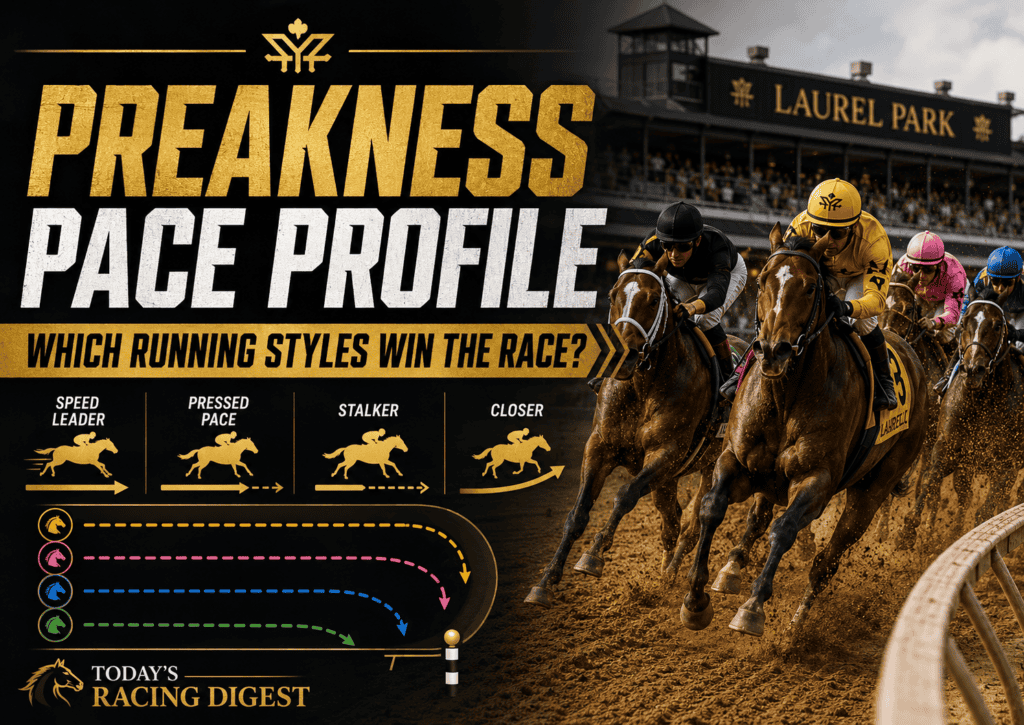
Preakness pace profile analysis is especially important for 2026 because this year’s race is not being run under normal Pimlico conditions. The 151st Preakness Stakes moves to Laurel Park while Pimlico is under redevelopment, and Kentucky Derby winner Golden Tempo is skipping the race, with the Belmont Stakes the likely next target. That leaves no Triple Crown bid on the line and makes pace, trip, post position, and running style even more important than usual.
The modern Preakness is a demanding 1 3/16-mile dirt race for 3-year-olds, and the 2026 edition brings a new wrinkle: a full 14-horse field at Laurel Park. That means the winner will likely need more than raw speed. We are looking for the horse that can secure position, avoid traffic, and still finish strongly through the final turn and stretch.
Digest Pro Tip
Do not reduce the Preakness pace picture to “speed wins” or “closers win.” The last eight winners show that the right profile is usually a horse with either early position or the ability to sustain a strong move late.
Preakness Winner Running Styles: Last Eight Runnings
Today’s Racing Digest pace study covers the last eight Preakness winners from 2018 through 2025. Those races were run at Pimlico, so this should be treated as a Preakness race-shape trend rather than a direct Laurel Park track-bias study. The sample includes each winner’s early running style, late running style, post position, final odds, and result.
| Year | Winner | Early Style | Late Style | Post | Odds |
|---|---|---|---|---|---|
| 2018 | Justify | F | F | 7 | 0.40 |
| 2019 | War of Will | M | M | 1 | 6.10 |
| 2020 | Swiss Skydiver | M | F | 4 | 11.70 |
| 2021 | Rombauer | M | M | 6 | 11.80 |
| 2022 | Early Voting | P | F | 5 | 5.70 |
| 2023 | National Treasure | F | F | 1 | 2.90 |
| 2024 | Seize the Grey | F | F | 5 | 9.80 |
| 2025 | Journalism | R | R | 2 | 1.00 |
The first takeaway is that Preakness winners have not come from one single running style. Frontrunners have won. Midpack runners have won. A rear-running style won in 2025. But the broader trend still matters: most winners were not hopelessly detached early, and most had enough positional or finishing ability to stay involved when the race got serious.
Early Running Style Winners
The early-running-style breakdown shows a split between frontrunners and midpack runners. In the supplied eight-year sample, frontrunners won three times, midpack runners won three times, early runners won once, and rear runners won once.
| Early Style | Winners | Win % |
|---|---|---|
| Frontrunner / F | 3 | 37.5% |
| Midpack / M | 3 | 37.5% |
| Pace Presser / P | 1 | 12.5% |
| Rear / R | 1 | 12.5% |
That tells us not to blindly chase early speed. Yes, speed has been dangerous. But midpack horses have won at the same rate as frontrunners in this sample. The Preakness has rewarded horses who can either make their own trip or settle into a comfortable stalking position and produce a sustained move.
Bettor’s Edge
The early pace data does not say “only speed wins.” It says the winner usually needs a practical trip — either forward enough to control position or tactical enough to stay within striking range.
Late Running Style Winners
The late-running-style data is especially important: five of the last eight winners carried an F late-style label, meaning they were still forward or finishing from a forward position when the race was being decided. Two were M, and one was R.
| Late Style | Winners | Win % |
|---|---|---|
| F | 5 | 62.5% |
| M | 2 | 25.0% |
| R | 1 | 12.5% |
This is the more useful handicapping clue. The Preakness has not simply been about who is fastest early. It has been about who can still be strong late. Horses that can carry their speed, sustain position, or move into the race before the stretch have had the strongest winning profile.
That matters in 2026 because a full 14-horse field can make a true deep-closing trip difficult. A late runner can win, but a horse who needs everything to collapse and then has to pass most of the field may be facing a lower-percentage setup.
Winning Style Combinations
The combined early-and-late running-style profile gives us a better look at how Preakness winners have actually won.
| Style Combo | Winners | Win % |
|---|---|---|
| F / F | 3 | 37.5% |
| M / M | 2 | 25.0% |
| P / F | 1 | 12.5% |
| M / F | 1 | 12.5% |
| R / R | 1 | 12.5% |
The strongest individual combination was F/F, with three winners. That means horses who were forward early and remained forward late accounted for 37.5% of the winners in this sample. But M/M and M/F types combined for three winners as well, meaning tactical midpack runners have been just as important to the race’s recent history.
The profile we do not want to overuse is the one-dimensional horse. Pure need-the-lead speed can be vulnerable if pressured. Deep closers can be vulnerable if the pace does not collapse. The best Preakness pace profile is usually a horse that can adapt: break cleanly, secure position, avoid traffic, and still finish.
Post Position and Pace: Why the Draw Still Matters
The post-position data from the last eight Preakness races also supports a trip-based approach. Posts 1 and 5 each produced two winners in the sample. Posts 2, 4, 6, and 7 each produced one winner. Posts 8 through 13 did not produce a winner in this eight-year dataset.
| Post | Starters | Winners | Win % | ITM % |
|---|---|---|---|---|
| 1 | 8 | 2 | 25.0% | 25.0% |
| 2 | 8 | 1 | 12.5% | 25.0% |
| 3 | 8 | 0 | 0.0% | 37.5% |
| 4 | 8 | 1 | 12.5% | 25.0% |
| 5 | 8 | 2 | 25.0% | 50.0% |
| 6 | 8 | 1 | 12.5% | 37.5% |
| 7 | 8 | 1 | 12.5% | 37.5% |
| 8 | 7 | 0 | 0.0% | 28.6% |
| 9 | 5 | 0 | 0.0% | 40.0% |
| 10 | 3 | 0 | 0.0% | 33.3% |
| 11 | 2 | 0 | 0.0% | 0.0% |
| 12 | 1 | 0 | 0.0% | 0.0% |
| 13 | 1 | 0 | 0.0% | 0.0% |
This does not mean we automatically toss every outside horse in 2026. The sample is small, and this year’s race is at Laurel Park instead of Pimlico. But the pattern still reinforces the same handicapping idea: trip matters. The farther outside a horse draws, the more important tactical speed and rider intent become.
Pro Insight
In a full field, post position and pace are connected. Outside horses need either enough early speed to avoid losing ground or enough price to justify the trip risk.
What the 2026 Preakness Pace Profile Should Look Like
For 2026, we should not simply look for the fastest horse early. The better question is: which horses can combine pace, position, and finish at Laurel Park?
Based on the figure analysis, several horses have enough pace to shape the race. Napoleon Solo owns the biggest Pace Fig in the supplied data, but that number comes from an older race line and is paired with a lower CPR. Robusta, Iron Honor, Taj Mahal, Talkin, Corona de Oro, and Chip Honcho also show pace ability. That creates the possibility of pressure if too many riders try to secure early position.
That is why the most appealing profile is not necessarily a need-the-lead horse. It may be a tactical runner who can sit just behind the first flight and finish. Historically, that kind of horse has fit the Preakness well, and in a 14-horse Laurel Park version, the ability to stay close without getting cooked could be decisive.
How This Applies to the Main 2026 Contenders
Taj Mahal
Taj Mahal fits the pace-profile conversation because he combines tactical speed with finishing strength. His supplied Laurel Park stakes line includes a 152 Pace Fig, 151 CPR, and 149 Final Fig. That is the type of balance we want in a race where forward ability matters but finish still decides the winner.
Betting Takeaway
Strong pace-profile fit. The rail draw requires a clean break, but his local form and tactical figures make him one of the best matches for the historical pace profile.
Iron Honor
Iron Honor is the morning-line favorite and owns enough tactical pace to be dangerous. His 152 Pace Fig gives him the ability to stay involved, but his figures do not create a dominant edge over the other top contenders.
Betting Takeaway
Logical and usable, but not automatic. He fits the race if he gets position without being forced wide or too aggressive early.
Incredibolt
Incredibolt owns the best Final Fig in the supplied figure data, but his outside draw makes pace and position more important. From Post 12, he cannot afford to lose too much ground or be forced into a premature move.
Betting Takeaway
Major win threat on final-time strength, but trip is the key. He needs to avoid the wide-post trap.
Robusta
Robusta has the strongest Fire Number in the supplied data and a sharp 155 Pace Fig. That makes him dangerous, but also raises the question of whether he may be part of a contested pace.
Betting Takeaway
Usable in exotics, especially if the price is right. The concern is whether he does too much too soon.
The Hell We Did
The Hell We Did has the top CPR in the supplied data and a strong 149 Final Fig, but his lower Pace Fig suggests he may not be as naturally forward as some of the others. That makes race shape important.
Betting Takeaway
Interesting underneath and possibly dangerous if the pace gets honest. He needs to stay close enough to use his finish.
How to Use Today’s Racing Digest for Pace Analysis
The Race Sheets help bettors compare projected figures, running styles, pace roles, and race shape in one place. That matters in a race like the Preakness because the best horse on raw ability is not always the horse who gets the right trip.
Fractional Charting adds depth to Preakness pace analysis by showing how each horse is projected to move through the race at the early, middle, and late calls. Instead of relying only on final speed figures, bettors can use Fractional Charting to visualize the likely race flow, identify possible speed duels, spot false favorites that may not fit today’s pace matchup, and find late runners who could benefit if the early pace gets too hot.
Fast Figs provide a quick class-and-performance comparison against today’s race level. For the Preakness, they can help identify which runners truly fit the field and which horses may be stepping up from races that look strong on paper but may not translate to a Grade 1 test.
Quick Picks give bettors a fast starting point for top choices, longshots, and betting strategies . They are most powerful when used with pace figures, running styles, Track Profile, and post-position data to confirm whether the selection has the right setup for today’s race.
The Track Profile adds another layer by showing which running styles have been winning at the track, distance, and surface. For the 2026 Preakness at Laurel Park, that means bettors should compare each horse’s expected running style against how Laurel dirt routes have been playing.
The Post Position Winners by Size of Field report helps complete the picture. Pace and post position work together, especially in full fields where a bad draw can force a horse into a tough early decision.
Digest Pro Tip
Use pace figures to identify who can be involved early, then use Final Fig and CPR to decide who can keep running late.
Final Betting Takeaway
The last eight Preakness winners show that the race is not controlled by one running style. Frontrunners and midpack runners each won three times by early style, while late-style F runners won five of eight. That points to a practical conclusion: the Preakness rewards horses who can stay involved and sustain their run.
For 2026 at Laurel Park, the best pace-profile horses are likely to be those with tactical speed, enough position to avoid traffic, and enough finishing strength to handle 1 3/16 miles. Pure speed is vulnerable if pressured. Deep closers are vulnerable if the pace does not collapse. The strongest betting profiles are the horses that can break, settle, stay within range, and still finish.
Get your picks and handicapping information for Preakness Weekend and Laurel Park here: Preakness & Black-Eyed Susan Picks and Tips