The Digest Race Sheets Core Features
Choose a path below. Start with the basics if you are new to the Digest, or switch to the second path to see how the Race Sheet’s ratings, analysis, class tools, pace projections, trainer stats, comments, and data lines work together.
Learn the Digest Race Sheets
Get More From the Digest Race Sheet
Overview
Race Setup
Interactive Race Sheet Tutorial
Race Setup
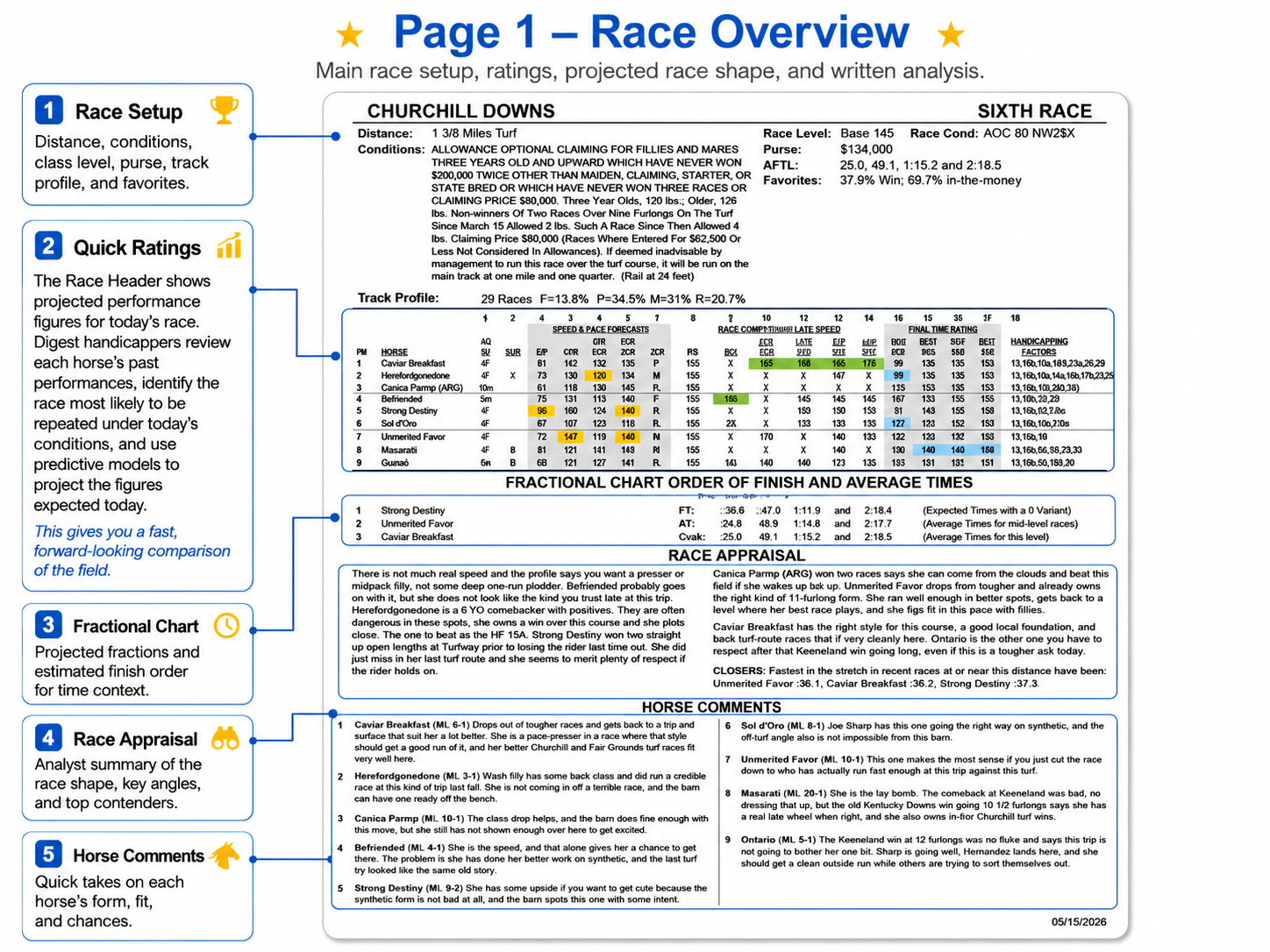
Start here to understand the race before comparing the horses. The blue hotspots explain the basic race information, including the field, distance, surface, race conditions, class level, purse, track profile, favorite trends, and projected race shape.
Roll over or tap each blue hotspot on the Race Sheet to learn what that item means and how it helps you understand today’s race.
Race Setup Hotspots
Distance: Shows how far today’s race will be run. Some horses are better sprinting, while others need longer races. If this was a turf race, we'd also note that here.
Tip: Compare this with BST DIST, PER, and Track Profile.
Race Conditions: Describes the type of race being run and the eligibility rules for the horses entered.
Tip: Use this with Race Level to understand how tough today’s assignment is.
Race Conditions: This is the abbreviated version of the race conditions. It gives experienced users a faster way to identify the race type.
Tip: Use the full Race Conditions text when the abbreviation is unfamiliar.
Track Profile: Shows which running styles have been winning at this distance, such as frontrunners, pressers, midpack runners, or late runners.
Tip: Compare this with each horse’s PER running style in column 7.
Race Level: Shows the class strength of today’s race using the Digest’s Race Competition Level system. Higher numbers mean tougher races.
Tip: Compare today’s Race Level with each horse’s RRL, RCL, PST CLS, and AVG RCL.
Purse – Shows the total prize money available in the race. Larger purses often indicate stronger or more important races.
Tip: Use purse as context, but rely more on Race Level when judging class.
AFTL: Stands for Average For The Level. These are par times for this class of race under normal conditions.
Tip: Use AFTL as a benchmark for whether horses have run fast enough for this level.
Favorites: Shows how often favorites have won or finished in the money under similar race conditions.
Tip: If favorites perform poorly in this type of race, be more open to alternatives.
Post Position Order
Horses are listed in post-position order when the Race Sheet is produced. This is not always the final betting or program number.
Tip: Always confirm the final program number before placing a wager, especially because Race Sheets are produced several days before post time.
Horse
This is the horse’s name. Each row belongs to one horse, and the ratings across that row apply to that horse.
Tip: Read across the row to compare that horse’s speed, class, running style, equipment, and Handicapping Factors.
Age/Sex
Shows the horse’s age and sex, such as colt, gelding, filly, mare, horse, or ridgling.
Tip: Age and sex can affect how a horse fits today’s race, especially when younger horses face older horses or females face males.
Equipment
Shows equipment or race-day designations for the horse, such as blinkers, front wraps, four wraps, Lasix, shadow roll, or claimed-out notation.
Tip: Equipment can help explain changes in focus, running style, soundness concerns, or race-day setup. Pay extra attention when equipment changes from one race to the next.
ET — Expected Times
ET shows the projected times today’s field is expected to run at key points in the race, based on the Digest’s Fractional Charting.
Tip: Compare the ET line with AFTL to see whether today’s field projects faster or slower than the average times for this race level.
AT — Average Times
AT shows the average times for mid-level races at today’s distance and surface.
Tip: Compare AT with ET and AFTL. ET shows what today’s field is projected to run, while AFTL shows the average times for today’s race level.
AFTL — Average For The Level
AFTL shows the average times for today’s specific race level. It acts like a par-time benchmark for the class of horses running in this race.
Tip: Compare AFTL with ET. If ET is faster than AFTL, today’s field projects strong for the level. If ET is slower, the race may be softer or less predictable.
Go Deeper: How to Use Race Setup
The hotspots above give quick definitions for each Race Setup item. The sections below explain how those items work together so you can understand the race before comparing individual horses.
Start with the race conditions, distance, surface, class level, and expected race shape. Then use the horse-by-horse ratings and comments to decide which horses fit today’s assignment.
The goal is simple: understand the race first, then evaluate the horses.
1. Race Identity: What Kind of Race Is This?
Before comparing horses, start by understanding the race itself. The Race Setup information tells you the distance, surface, race type, eligibility rules, and overall conditions of today’s race. This gives context for every rating and comment that follows.A horse may look strong on paper, but the race has to fit. Distance, surface, age restrictions, claiming price, allowance conditions, maiden status, and other eligibility rules can all affect whether a horse is in the right spot today.
Distance and Surface
The distance tells you how far the race will be run. The surface tells you whether the race is on dirt, turf, or synthetic. Some horses are better in short sprints, while others need longer races to show their best finish. Some horses move up sharply on turf or synthetic, while others are more effective on dirt.
How to use it: Compare today’s distance and surface with the horse’s past races, BST DIST, BST SUR, running style, and Horse Comments. A horse that has already run well under similar conditions is usually easier to trust.
Race Conditions
Race Conditions describe who is eligible to run and what type of race this is. Conditions may include maiden races, claiming races, allowance races, optional claiming races, starter races, age restrictions, sex restrictions, claiming price, or non-winners conditions.
How to use it: Race Conditions help explain why a horse is in this spot. A horse may be protected from being claimed, dropped into easier company, moved up after a strong effort, or placed in a condition where it has a better chance to compete.
Abbreviated Race Conditions
The abbreviated condition line gives experienced users a faster way to identify the race type. It condenses the full race conditions into a shorter format.
How to use it: Use the full Race Conditions text when the abbreviation is unfamiliar. Once you understand the abbreviations, they help you quickly recognize whether a race is a maiden claimer, allowance, optional claimer, starter allowance, or another condition type.
How to Use This Section
Start by asking: What kind of race is this, and what kind of horse usually fits here? Then compare each horse’s recent races, class ratings, distance/surface history, and comments to today’s assignment.
2. Class & Race Strength: How Tough Is Today’s Race?
Class is one of the most important parts of handicapping. The Race Setup area helps you judge how tough today’s race is before you decide whether each horse fits.The Digest simplifies class by assigning a numerical Race Level. This lets you compare today’s race to the levels where each horse has recently competed, instead of relying only on race names, purse values, or claiming prices.
Race Level
Race Level shows the class strength of today’s race using the Digest’s Race Competition Level system. Higher numbers mean tougher races. This is one of the most important reference points on the Race Sheet because many other class ratings should be compared back to today’s Race Level.
How to use it: Compare today’s Race Level with each horse’s RRL, RCL, PST CLS, AVG RCL, BST SUR, and BST DST. A horse with several class ratings close to today’s Race Level usually fits better than one whose proven class is far below today’s assignment.
Purse
Purse shows the total prize money available in the race. Larger purses often attract stronger horses, but purse size alone does not always tell the full class story. Some races have inflated purses because of state-bred programs, incentives, conditions, or meet-specific purse structures.
How to use it: Use purse as context, but rely more heavily on Race Level when judging class. Race Level is designed to make class comparison cleaner and more consistent.
Class Fit
A horse does not need to have run in the exact same kind of race before, but it should show some evidence that today’s class level is realistic. That evidence may come from recent class ratings, strong projected figures, improving form, favorable comments, or a class drop.
What to watch for: A horse moving up sharply needs a reason to improve. A horse dropping sharply may be dangerous, but it can also signal declining form or physical concerns.
How to Use This Section
Start with today’s Race Level. Then ask whether each horse has already shown it can compete near that level. If a horse’s figures are strong but its class ratings are weak, look for another reason to support it before treating it as a main contender.
3. Distance, Surface & Race Shape
The Race Setup section does more than identify the race. It also gives you tools for understanding how the race may be run. Distance, surface, expected times, average times, and class-level par times help you judge whether today’s race projects fast, slow, demanding, or favorable to certain running styles.
ET — Expected Times
ET shows the projected times today’s field is expected to run at key points in the race. These expected times are based on the Digest’s Fractional Charting and help estimate how fast today’s field may run during the race.
How to use it: Compare ET with the horses’ running styles and pace figures. If today’s ET projects a fast early pace, frontrunners may be pressured and closers may become more interesting. If ET projects a softer pace, a horse with early speed may be able to control the race.
AT — Average Times
AT shows the average times for mid-level races at today’s distance and surface. This gives you a general benchmark for how races of this type are commonly run.
How to use it: Use AT as a broad reference point. Then compare it with ET and AFTL. ET tells you what today’s field is projected to run, while AFTL tells you what is typical for today’s specific race level.
AFTL — Average For The Level
AFTL shows the average times for today’s specific race level. It acts like a par-time benchmark for the class of horses running in this race.
How to use it: Compare ET with AFTL. If ET is faster than AFTL, today’s field may project strong for the level. If ET is slower than AFTL, the race may be softer, slower, or more dependent on trip and pace.
Race Shape
Race shape is the expected flow of the race. It considers how many horses want the lead, how fast the pace may be, whether there is pressure up front, and which running styles may get the best trip.
What to watch for: A good horse can be compromised by the wrong setup. A frontrunner may struggle if several others also need the lead. A closer may struggle if the pace is too slow. Race shape helps explain why the best figure horse is not always the best bet.
How to Use This Section
Use ET, AT, and AFTL to understand whether today’s race projects fast or slow for the level. Then compare that expected race shape with each horse’s PER, running style, Track Profile, and Horse Comments.
4. Track Profile, Favorites & Field Context
Race Setup also gives you context about how similar races have been playing. Track Profile and Favorites data help you understand whether certain running styles or betting patterns have been more successful in similar situations.
Track Profile
Track Profile shows which running styles have been winning at this distance and surface, such as frontrunners, pace pressers, mid-pack runners, or late runners. It helps you understand whether the race setup may favor speed, stalking types, or closers.
How to use it: Compare Track Profile with each horse’s PER running style. If the profile favors pressers and a contender has a P running style, that horse may fit the expected race shape better than a deep closer or need-the-lead type.
What to watch for: Track Profile is a guide, not a rule. Race shape, track condition, field size, and the quality of the individual horses still matter.
Favorites
Favorites data shows how often favorites have won or finished in the money under similar race conditions. This helps users understand whether similar races have tended to be predictable or more chaotic.
How to use it: If favorites perform well in this type of race, short-priced contenders may be more reliable. If favorites perform poorly, be more open to alternatives, especially horses with strong class fit, pace advantage, or positive Handicapping Factors.
Field Context
Field context means understanding today’s group as a whole. A race with several evenly matched horses may require a different betting approach than a race where one or two horses clearly stand out.
How to use it: After reviewing Race Level, Track Profile, Favorites, and projected times, ask whether the race looks predictable, wide open, pace-dependent, or vulnerable to an upset.
How to Use This Section
Use Track Profile and Favorites data to understand the race environment. Then confirm that view with the horse-by-horse ratings, class tools, Race Appraisal, and Horse Comments.
5. Horse Basics: Reading the Horse Row
The horse row organizes the basic information for each horse before you get into the ratings, comments, and past performances. These details may seem simple, but they help you avoid mistakes and understand each horse’s setup for today.
Post Position Order
Horses are listed in post-position order when the Race Sheet is produced. This is not always the final betting or program number, especially because Race Sheets may be produced before final changes, scratches, or updates.
How to use it: Use the Race Sheet to handicap the race, but always confirm the final program number before placing a wager.
Horse Name
Each row belongs to one horse. The ratings across that row apply to that horse, including projected figures, class ratings, final-time ratings, Handicapping Factors, and other key information.
How to use it: Read across the row to understand the full case for one horse. Then compare horses by looking down the same column across the field.
Age/Sex
Age/Sex shows the horse’s age and sex, such as colt, gelding, filly, mare, horse, or ridgling. These details can matter because younger horses may still be developing, older horses may be more established, and females may be facing males in some race types.
How to use it: Pay attention when younger horses face older horses, when fillies or mares face males, or when a horse is newly gelded. These situations can affect performance and improvement potential.
Equipment
Equipment shows race-day designations such as blinkers, front wraps, four wraps, Lasix, shadow roll, or claimed-out notation. Equipment can help explain changes in focus, speed, soundness, or running style.
How to use it: Equipment is most useful when it changes. A new equipment change may signal an attempt to improve focus, add speed, correct a problem, or respond to a prior poor effort.
What to watch for: Equipment notes are clues, not automatic upgrades or downgrades. Use them with Horse Comments, trainer patterns, workouts, and recent races.
How to Use This Section
Start by identifying the horse and confirming the final program number. Then read across the row to build the horse’s case. After that, compare the same rating columns across all horses to see who stands out.
Quick Ratings
Interactive Race Sheet Tutorial
Quick Ratings
Use this section to quickly compare the most important ratings for each horse in today’s race. The Quick Ratings summarize projected speed, pace, class fit, final-time ability, and key handicapping angles in one compact row.
Many of these numbers are forward-looking. Digest handicappers review each horse’s past performances, identify the race most likely to be repeated under today’s conditions, and use predictive models to project how the horse is expected to perform today.
Roll over or tap the colored hotspots to learn what each rating means. Use the color key below to separate projected speed and pace, race competition levels, proven final-time ratings, and Digest Handicapping Factors.
Final Time Ratings
FIRE Number
Unlike speed figures that focus only on final time, the FIRE Number is based on the horse’s speed throughout the entire race. In the Race Header, we show the FIRE Number we expect the horse to earn in today’s race, giving you a fuller view of its projected overall performance and making it easier to compare contenders.
FIRE is based on a 100 par, while many of the Digest’s other figures are based on a 150 par.
Tip: Higher is better. About two FIRE points equals roughly one length.
CPR — Comprehensive Performance Rating
CPR is a Digest performance rating that takes pace, final time, closing strength, and track variant into account. In the Race Header, we show the CPR we expect the horse to earn in today’s race.
Tip: Higher is better. Use CPR with FIRE and Fast Fig to see which horses are competitive across more than one rating.
Fast Fig
Fast Fig is an AI-driven performance figure that combines speed, pace, and strength of field into one number. In the Race Header, we show the Fast Fig we expect the horse to earn in today’s race.
Tip: Higher is better. Horses within five points of the top Fast Fig should usually be considered contenders.
FNL RAT — Final Time Rating
The Final Time Rating measures a horse’s final time against the Digest’s track pars, with the daily track variant factored in. A horse equaling the track par for the distance would earn a 150 Final Time Rating, with three points deducted for each length slower than par.
Tip: Higher is better. Use FNL RAT to compare how strongly each horse is expected to finish in today’s race.
PER — Performance Early in Race
PER shows the horse’s expected running style in the early part of today’s race: F = Frontrunner, P = Pace Presser, M = Mid-pack runner, and R = Rear runner / late runner.
Tip: Compare PER with the Track Profile to see whether today’s race setup may favor that horse’s running style.
RRL — Recent Race Level
RRL shows the Race Competition Level of the horse’s last race. It helps you see the class level the horse most recently competed against.
Tip: Compare RRL to today’s Race Level. If today’s Race Level is higher, the horse is moving up in class. If it is lower, the horse may be dropping into easier company.
RCL — Race Competition Level
RCL shows the highest class level where the horse has been competitive locally within the last 90 days. It helps you judge whether the horse has recently proven it can compete near today’s level.
Tip: Compare RCL to today’s Race Level. A horse with an RCL close to or above today’s Race Level usually fits the class of the race better.
BST SUR — Best Surface Class Rating
BST SUR shows the highest Race Competition Level where the horse has been competitive on today’s surface, such as dirt, turf, or synthetic, within the past six months.
Tip: Compare BST SUR to today’s Race Level. A strong number means the horse has already shown it can handle this surface at or near today’s class level.
BST DST — Best Distance Class Rating
BST DST shows the highest Race Competition Level where the horse has been competitive at today’s distance type, such as a sprint or route, within the past six months.
Tip: Compare BST DST to today’s Race Level. A strong number means the horse has already shown it can handle this type of distance at or near today’s class level.
PST CLS — Past Class
PST CLS shows the highest Race Competition Level where the horse has been effective in the past. It helps identify horses that may have handled stronger company before, even if their recent races are at a lower level.
Tip: Strong past class matters most when the horse also shows signs of current form or improvement.
AVG RCL — Average Race Competition Level
AVG RCL shows the horse’s average recent Race Competition Level in races where it was competitive. It is based on qualifying races from the past six months.
Tip: Compare AVG RCL to today’s Race Level. A horse with an AVG RCL close to today’s Race Level has shown it can compete around this class level more than once.
LST RAT — Last Race Final Time Rating
LST RAT shows the Final Time Rating the horse earned in its last start. It gives you a quick look at how strongly the horse finished in its most recent race.
Tip: Higher is better. A strong LST RAT is most useful when today’s race is similar in distance, surface, and class.
BST RAT — Best Final Time Rating
BST RAT shows the highest Final Time Rating the horse has earned in its lifetime. It gives you a quick look at the horse’s best proven final-time performance.
Tip: A strong BST RAT shows upside, but current form still matters. Use it with LST RAT to see whether the horse is still running near its best.
BST SUR — Best Surface Rating
BST SUR shows the best Final Time Rating the horse has earned on today’s surface, such as dirt, turf, or synthetic.
Tip: Surface matters. A strong BST SUR is more useful when today’s race is on the same surface where the horse has already run well.
BST DIST — Best Distance Rating
BST DIST shows the best Final Time Rating the horse has earned at today’s distance type, such as a sprint or route.
Tip: Use BST DIST to see whether the horse has already shown finishing ability at a similar distance. A strong rating helps confirm that today’s trip fits.
Handicapping Factors (HF's)
Handicapping Factors are Digest specific short codes used to point out important angles, clues, and potential concerns for each horse. They can flag things like class changes, equipment changes, layoffs, pace issues, trouble, improving form, longshot potential, or whether a horse fits today’s race.
Tip: Use Handicapping Factors as quick clues, not automatic picks. The strongest cases usually combine positive HF codes with competitive ratings, class fit, and good current form.
Quick Ratings: Learn What Each Number Means
The guide below explains what each colored hotspot group means and how the Quick Ratings help compare projected speed, class fit, final-time strength, and key handicapping angles.
How to Read the Colored Hotspots
Final Time Ratings
Each hotspot color represents a different type of Quick Rating. Use this legend first, then click or tap the colored icons on the Race Sheet to learn what each rating means.
Gold: Speed & Pace Forecasts
These ratings show what the Digest expects each horse to do in today’s race. Our handicappers review each horse’s past performances, identify the race most likely to be repeated under today’s conditions, and use our predictive models to project today’s expected figures.
This section includes FIRE, CPR, Fast Fig, FNL RAT, and PER. Use these numbers to compare projected speed, overall performance, final-time ability, and expected running style.
Green: Race Competition Levels
These ratings help show whether each horse has been competitive at the kind of class level it faces today. They make it easier to see whether a horse is moving up, dropping down, or fitting today’s class level.
This section includes RRL, RCL, BST SUR, BST DST, PST CLS, and AVG RCL. Use these numbers with today’s Race Level to judge whether the horse belongs in this race from a class standpoint.
Blue: Final Time Ratings
These ratings focus on how well a horse has finished in previous races. They help you compare recent final-time strength, lifetime best ability, and proven performance on today’s surface or distance.
This section includes LST RAT, BSTRAT, BST SUR, and BST DIST. Use these ratings to see whether a horse has already shown the ability to finish strongly under similar conditions.
Purple: Handicapping Factors
Handicapping Factors are short codes that point out important angles, positives, concerns, or special situations for each horse.
Use these as quick clues for things like class changes, equipment changes, layoffs, pace concerns, trouble, improving form, longshot potential, or whether a horse fits today’s race.
Go Deeper: How to Use the Quick Ratings
The color guide above gives you the basic purpose of each Quick Ratings group. The sections below explain how those ratings work in more detail and how to apply them when comparing horses.
Use the hotspots for quick definitions while looking at the Race Sheet. Then use the expandable sections below to understand the bigger handicapping picture: which horses project fastest, which ones fit today’s class, who has proven final-time ability, and which Handicapping Factors may confirm or challenge your opinion.
Start with the group that matches the question you are trying to answer.
Speed & Pace Forecasts: What We Expect Today
The Speed & Pace Forecasts section is one of the fastest ways to compare the horses in today’s race. These figures are not simply copied from a horse’s last start. Digest handicappers review each horse’s past performances, identify the race that best fits today’s distance, surface, class level, and expected setup, and then use predictive models to project the figures each horse is expected to earn today.
This is important because horseplayers are not only trying to know what a horse has done before. They are trying to estimate what the horse is most likely to do today. The Speed & Pace Forecasts help turn a long set of past performances into a quick, forward-looking comparison of the field.
Ratings Included in This Section
FIRE Number
The FIRE Number is the Digest’s comprehensive speed figure. Unlike speed figures that focus only on final time, FIRE is based on a horse’s speed throughout the entire race. This gives a broader view of the horse’s overall performance, including how it ran at different stages, not just how fast it finished.
In the Race Header, the FIRE Number shown is the figure the Digest expects the horse to earn in today’s race. This makes it a forward-looking rating, not just a historical number. The higher the FIRE Number, the stronger the projected performance.
How to use it: Start by identifying the horses with competitive FIRE Numbers. A horse does not always need the top FIRE Number to win, but it usually needs to be close enough to the best projected horses to be considered a serious contender.
Quick guide: FIRE is based on a 100 par, while many other Digest figures are based on a 150 par. About two FIRE points equals roughly one length, so even small differences can matter when comparing closely matched horses.
CPR — Comprehensive Performance Rating
CPR stands for Comprehensive Performance Rating. It is one of the Digest’s core performance figures and is designed to give a more complete view of a horse’s race than final time alone. CPR takes pace, final time, closing strength, and track variant into account.
In the Race Header, the CPR shown is the CPR the Digest projects the horse to earn in today’s race. The goal is to identify the kind of performance the horse is expected to produce under today’s conditions.
How to use it: Use CPR to compare overall expected performance. A horse with a strong CPR may be especially interesting when it also has a competitive FIRE Number and Fast Fig.
What to watch for: CPR can help identify horses that have more balanced ability, not just one standout trait. A horse that combines solid pace, finishing ability, and overall performance strength is often more dependable than a horse with only one flashy number.
Fast Fig
Fast Fig is an AI-driven performance figure that combines speed, pace, and strength of field into one number. It is designed to help identify horses that not only have speed, but also the experience and ability to compete at today’s race class level.
In the Race Header, the Fast Fig shown is the figure the Digest expects the horse to earn in today’s race. It gives you another way to compare the field, especially when trying to identify contenders and possible overlays.
How to use it: Stack the Fast Figs and look for horses within range of the top figure. Horses within five points of the top Fast Fig should usually be treated as contenders unless other factors create serious concerns.
What to watch for: Fast Fig is most useful when it agrees with other positive evidence. A strong Fast Fig supported by FIRE, CPR, race fit, and class fit can point to a horse that deserves serious attention.
FNL RAT — Final Time Rating
FNL RAT stands for Final Time Rating. It measures a horse’s final time against the Digest’s track pars, with the daily track variant factored in. A horse equaling the track par for the distance would earn a 150 Final Time Rating. Three points are deducted for each length slower than par.
In this Speed & Pace Forecasts section, FNL RAT is the Final Time Rating the Digest expects the horse to earn in today’s race. That makes it different from the later Final Time Ratings group, which shows what the horse has already earned in previous races.
How to use it: Use FNL RAT to compare expected finishing strength. If several horses are close in FIRE, CPR, or Fast Fig, the projected FNL RAT can help separate horses that may finish stronger today.
What to watch for: Final time can be affected by pace. A horse that gets an easy lead may finish faster than expected, while a horse caught in a speed duel may finish slower. Use FNL RAT together with PER and Track Profile to understand the likely race shape.
PER — Performance Early in Race
PER shows the horse’s expected running style in the early part of today’s race. It helps you visualize where the horse is likely to be positioned after the start and through the early stages of the race.
The common PER designations are: F = Frontrunner, P = Pace Presser, M = Mid-pack runner, and R = Rear or Late runner. An X means the running style is unknown or unavailable.
How to use it: Compare each horse’s PER with the Track Profile. If the Track Profile shows that pressers have been winning at this distance, a horse marked P may fit the race shape better than a deep closer.
What to watch for: Running style can make or break a contender. A good horse can be compromised if the pace setup does not fit. For example, too many frontrunners can create a speed duel, while a race with little early speed may favor the horse most likely to control the pace.
How to Use Speed & Pace Forecasts
Start by looking for horses that are competitive in more than one rating. A horse that looks strong in FIRE, CPR, Fast Fig, and FNL RAT deserves attention, especially if its PER running style also fits the Track Profile.
Do not rely on one number by itself. The strongest contenders usually show a combination of projected speed, overall performance, class fit, finishing ability, and pace suitability.
A practical way to use this section is to first identify the top projected horses, then check whether their running styles fit the race. From there, use the Race Competition Levels, Final Time Ratings, Handicapping Factors, Race Appraisal, and Horse Comments to confirm or challenge the initial view.
Race Competition Levels: Does the Horse Fit the Class?
The Race Competition Levels section helps you answer one of the most important handicapping questions:
is this horse good enough for today’s race? A horse may look fast on speed figures, but if those figures were earned against easier competition, it still may not fit today’s class level.
Today’s Racing Digest simplifies class by converting race conditions into a numerical Race Competition Level. Instead of trying to compare complicated race conditions by eye, you can compare the numbers. Higher numbers represent tougher races, and generally, five points equals one class level.
The key is to compare each horse’s class ratings to today’s Race Level. This helps you see whether the horse is moving up, dropping down, staying at a similar level, or returning to a level where it has already been competitive.
Ratings Included in This Section
RRL — Recent Race Level
RRL stands for Recent Race Level. It shows the Race Competition Level of the horse’s last race. This gives you a quick look at the class level the horse most recently faced.
How to use it: Compare RRL to today’s Race Level. If today’s Race Level is higher than the horse’s RRL, the horse is moving up in class. If today’s Race Level is lower, the horse may be dropping into easier company.
What to watch for: A class drop can be positive, but it can also be a warning sign if the horse is dropping because it has lost form. A class rise can be acceptable if the horse is improving, has strong figures, or has shown past class.
RCL — Recent Competitive Class Level
RCL shows the highest class level where the horse has been competitive locally within the last 90 days. This helps show whether the horse has recently proven it can compete near today’s level.
How to use it: Compare RCL to today’s Race Level. A horse with an RCL close to or above today’s Race Level has already shown recent competitiveness at a similar or stronger level.
What to watch for: If the RCL is much lower than today’s Race Level, the horse may need to improve to contend. If the column shows an X, the horse has not been competitive at a recent local class level.
BST SUR — Best Surface Class Rating
BST SUR shows the highest Race Competition Level where the horse has been competitive on today’s surface, such as dirt, turf, or synthetic, within the past six months.
How to use it: Use BST SUR to see whether the horse has already handled today’s surface at or near today’s class level. This is especially useful when horses are switching surfaces or returning to a preferred surface.
What to watch for: A horse may have good overall class but still be weaker on today’s surface. A strong BST SUR can confirm that the horse’s class holds up under today’s footing.
BST DST — Best Distance Class Rating
BST DST shows the highest Race Competition Level where the horse has been competitive at today’s distance type, such as a sprint or route, within the past six months.
How to use it: Compare BST DST to today’s Race Level to see whether the horse has proven it can compete at this type of distance against similar company.
What to watch for: A horse can be competitive sprinting but less effective routing, or the reverse. BST DST helps you avoid assuming that class at one distance automatically carries over to another.
PST CLS — Past Class
PST CLS shows the highest Race Competition Level where the horse has previously been effective. Two-year-old races are not included. This number helps show how much class the horse has shown in the past.
How to use it: Use PST CLS to identify horses with back class. A horse may not have shown much recently, but if it once competed effectively at a higher level, it may be dangerous when returning to form or dropping into a softer race.
What to watch for: Past class alone is not enough. It is most useful when supported by current form, recent workouts, positive comments, improving figures, or a favorable class drop.
AVG RCL — Average Race Competition Level
AVG RCL shows the horse’s average recent Race Competition Level in races where it was competitive. It is based on qualifying races from the past six months.
How to use it: Compare AVG RCL to today’s Race Level. A horse with an AVG RCL close to today’s Race Level has shown it can compete around this class level more than once.
What to watch for: AVG RCL can be more reliable than a single strong race because it reflects a pattern of competitiveness. If AVG RCL is much lower than today’s Race Level, the horse may be facing tougher company than it usually handles.
How to Use Race Competition Levels
Start with today’s Race Level, then compare each horse’s RRL, RCL, BST SUR, BST DST, PST CLS, and AVG RCL. You are looking for horses that have already competed effectively at or near today’s level.
A strong class fit usually means the horse has recent competitiveness, surface or distance proof, and class ratings that line up with today’s race. A horse that is moving up sharply needs another reason to support it, such as improving form, strong projected figures, favorable pace, or strong trainer intent.
The best use of this section is to separate horses that merely look fast from horses that have shown they can compete against the kind of company they face today.
Final Time Ratings: How Strongly Has the Horse Finished?
The Final Time Ratings section helps you compare how strongly each horse has finished in previous races. These ratings are based on a horse’s final time compared to the Digest’s track pars, with the daily track variant factored in.
A horse that equals the track par for the distance earns a 150 Final Time Rating. Three points are deducted for each length slower than par. That gives you a quick way to compare finishing ability across the field.
This section is different from the projected FNL RAT found under Speed & Pace Forecasts. The FNL RAT in that section is what the Digest expects the horse to earn today. The Final Time Ratings below show what the horse has already earned in past races.
Ratings Included in This Section
LST RAT — Last Race Final Time Rating
LST RAT shows the Final Time Rating the horse earned in its most recent start. This gives you a quick look at how strongly the horse finished last time it raced.
How to use it: A strong LST RAT can be a useful sign of current form, especially when today’s race is similar in distance, surface, and class.
What to watch for: Do not judge LST RAT by itself. A horse’s final time can be affected by pace, trip, surface condition, trouble, or a track bias. Use LST RAT with the horse’s comments, notes, pace setup, and today’s race conditions.
BST RAT — Best Final Time Rating
BST RAT shows the highest Final Time Rating the horse has earned in its lifetime. It gives you a quick view of the horse’s best proven final-time performance.
How to use it: Use BST RAT to understand the horse’s ceiling. A horse with a strong lifetime best may be capable of competing if there are signs it can return to that level today.
What to watch for: A strong lifetime best does not always mean the horse is ready to repeat it. Compare BST RAT with LST RAT, recent form, workouts, class level, and today’s race conditions.
BST SUR — Best Surface Final Time Rating
BST SUR shows the best Final Time Rating the horse has earned on today’s surface, such as dirt, turf, or synthetic.
How to use it: Surface matters. A horse may finish strongly on one surface but not run as well on another. BST SUR helps you see whether the horse has already shown strong final-time ability on today’s footing.
What to watch for: A horse with a strong overall Final Time Rating but a weaker BST SUR may be less reliable if it has not proven itself on today’s surface.
BST DIST — Best Distance Final Time Rating
BST DIST shows the best Final Time Rating the horse has earned at today’s distance type, such as sprint or route.
How to use it: Use BST DIST to see whether the horse has already shown finishing ability at a similar distance. This is especially helpful when horses are stretching out, cutting back, or returning to a preferred trip.
What to watch for: A horse may finish well sprinting but weaken going longer, or may need more distance to show its best late run. BST DIST helps you judge whether today’s distance fits the horse’s proven ability.
How to Use Final Time Ratings
Start with LST RAT to see how strongly the horse finished in its most recent race. Then compare that number with BST RAT to see whether the horse is currently running near its best.
Next, check BST SUR and BST DIST to see whether the horse has already finished well on today’s surface and at today’s distance type.
The strongest cases usually come from horses whose recent Final Time Rating, best surface rating, and best distance rating all support today’s race setup. If the ratings disagree, use the Race Appraisal, Horse Comments, pace setup, and Handicapping Factors to understand why.
Handicapping Factors: Short Codes for Key Angles
The Handicapping Factors section uses short codes to point out important positives, negatives, and special situations for each horse. These codes are designed to save space while giving you quick access to key handicapping clues that may affect how a horse performs today.
Handicapping Factors can flag things like class changes, equipment changes, layoffs, pace concerns, distance or surface questions, trouble, improving form, longshot potential, strong finishes, or whether a horse appears to fit today’s race.
These codes should not be treated as automatic picks or automatic tosses. They are best used as quick clues that help you know where to look next.
How to Think About Handicapping Factors
Positive Factors
Some Handicapping Factors point to positive clues. These may identify horses that appear live, improving, well-spotted, work-ready, capable of running well at a price, or a good fit for today’s race.
Examples: improving form, longshot potential, fits race, work ready, strong finish, won easily, or positive pick designations.
How to use them: Positive factors are strongest when they line up with the rest of the Race Sheet. A positive HF code becomes more meaningful when the horse also has competitive figures, class fit, and recent form.
Caution Factors
Some Handicapping Factors are warnings. They may point to distance concerns, surface concerns, pace problems, layoff questions, trouble-prone behavior, age concerns, or other risks that could make a horse vulnerable.
Examples: distance may be a problem, pace may not fit, surface may not suit, long layoff, poor post-position fit, trouble prone, tired, or no factor.
How to use them: A caution factor does not automatically eliminate a horse, but it should make you look closer. Check whether the horse’s figures, class, comments, workouts, or trainer stats help offset the concern.
Class and Race-Fit Factors
Some Handicapping Factors help explain whether today’s race fits the horse. These codes can point out whether a horse is moving up in class, dropping into easier company, or fitting the race except for one concern such as class, distance, or recency.
How to use them: Compare these factors with today’s Race Level, the horse’s RCL, RRL, PST CLS, and AVG RCL. This can help you decide whether the horse belongs at today’s level.
What to watch for: A horse dropping in class may be dangerous if it still has form. A horse moving up in class needs a reason to believe it can improve, such as strong projected ratings, improving form, or favorable race setup.
Equipment, Medication, and Physical Clues
Some Handicapping Factors identify changes or conditions that may affect how a horse performs today, such as blinkers, Lasix changes, leg wraps, or other equipment-related notes.
How to use them: Equipment and medication clues are best used with the Horse Comments, trainer stats, and past-performance lines. They can help explain why a horse may show more speed, relax better, improve, or regress.
What to watch for: Equipment changes can be positive or negative depending on the horse. Look for context in the comments or data lines before assuming the change is good or bad.
Trip and Last-Race Factors
Some Handicapping Factors help explain what happened in a horse’s recent race. These can be useful because a horse’s finish position does not always tell the full story.
A horse may have had trouble, raced on an off track, tired late, finished strongly, or won easily. These clues can help you decide whether the last race was better or worse than it looks on paper.
How to use them: Combine these codes with the Notes, Horse Comments, Track Bias, Position at Each Call, Last Fraction, and Final Time Ratings. A poor finish may be forgivable if the horse had legitimate trouble, while a good finish may be less impressive if the race setup was favorable.
Value and Betting Clues
Some Handicapping Factors can point to horses that may be worth a closer look at the right price. These may include longshot clues, betting action, improving form, or horses that fit the race but may not be obvious to the public.
How to use them: These factors are most useful after you have already identified contenders. If a horse has competitive ratings and a positive value-related HF code, it may be worth extra attention in win bets, exactas, trifectas, or other exotic wagers.
How to Use Handicapping Factors
Start by reading the HF codes as quick clues. Then ask whether the code is supported by the rest of the Race Sheet. A positive HF code is more powerful when the horse also fits the class, has competitive projected figures, and appears to be in current form.
For caution codes, do not automatically toss the horse. Instead, use the code as a reason to check the Horse Comments, trainer stats, workouts, trip notes, and data lines. Sometimes a caution factor explains why a horse is risky; other times the rest of the sheet may show that the concern is manageable.
The best use of Handicapping Factors is to help you quickly spot angles that deserve more attention. They are not a replacement for the ratings, class tools, Race Appraisal, or Horse Comments. They are a shortcut to help you know where to focus.
Analysis & Comments
Interactive Race Sheet Tutorial
Analysis & Comments
Use this section to understand the handicapper’s written view of the race. The blue hotspots explain the Race Appraisal and Horse Comments, including pace clues, trip notes, class context, form analysis, contender opinions, and possible value plays.
Roll over or tap each blue hotspot on the Race Sheet to learn how the analysis and comments help explain what the ratings may not show by themselves.
Analysis & Comments Hotspots
Race Appraisal
The Race Appraisal is the handicapper’s overview of how today’s race may unfold. It can explain pace, class, figure strength, vulnerable favorites, value horses, and which runners appear most likely to contend.
Tip: Read this after reviewing Race Setup and Quick Ratings. It helps connect the numbers to today’s actual race conditions.
Pace & Race Flow
This part of the analysis explains how the race may be run. It can point out early speed, pace pressure, lone-speed possibilities, closers, or horses that may benefit from the expected setup.
Tip: Compare this with PER, Track Profile, ET, and each horse’s running style.
Class & Figure Context
This part of the analysis explains whether the ratings fit today’s race. A horse may have strong numbers, but those numbers matter more when they were earned under similar class, distance, surface, and pace conditions.
Tip: Use this with Race Level, RCL, Fast Fig, FIRE, CPR, and Final Time Ratings to judge whether a horse truly fits today’s race.
Horse Comments
Horse Comments give the handicapper’s individual view of each runner. They may explain form, class fit, distance or surface concerns, pace setup, trip trouble, equipment changes, workouts, or improvement potential.
Tip: Read across the horse’s row first, then use the comment to confirm, question, or better understand what the ratings show.
Closers
The Closers line highlights horses expected to finish strongly late. They may not show early speed, but they can become dangerous if the pace up front is fast, contested, or tiring.
Tip: Compare Closers with the Pace & Race Flow comments, PER running style, Track Profile, and ET. A closer is most useful when the race setup gives late runners a chance.
Value & Betting Clues
This part of the analysis may point out horses that offer value, longshot potential, exotic-wager use, or reasons a favorite may be vulnerable.
Tip: Value horses are strongest when the comment is supported by competitive ratings, class fit, favorable pace, or positive Handicapping Factors.
Go Deeper: How to Use Analysis & Comments
The hotspots above give quick definitions for the Race Appraisal and Horse Comments areas. The sections below explain how to use those written opinions with the ratings, class tools, pace clues, and race setup.
The goal is to understand not just which horses have strong numbers, but why those numbers matter in today’s race and whether the handicapper’s comments support or challenge what the figures show.
Use the ratings to find contenders, then use the analysis and comments to understand the story behind them.
1. Race Appraisal: The Handicapper’s View of the Race
The Race Appraisal is the handicapper’s overview of the race. It helps explain how the race may be run, which horses appear strongest, where the value may be, and which horses may be vulnerable.
This section is especially useful because numbers alone do not always tell the full story. A horse may have strong figures but face the wrong pace setup, class test, surface change, distance question, or trip risk. The Race Appraisal helps connect the data to today’s actual race.
What the Race Appraisal Can Explain
The Race Appraisal may discuss expected pace, likely race shape, class strength, figure advantages, value horses, longshot possibilities, vulnerable favorites, and horses that may be overmatched or difficult to support.
How to Use It
Read the Race Appraisal after reviewing the Race Setup and Quick Ratings. It can help confirm the main contenders, explain why a lower-rated horse may still be usable, or point out why a horse with good numbers may not be as strong as it appears.
What to Watch For
Pay attention when the appraisal explains a race-flow advantage or disadvantage. A horse with the best figures can still be compromised by pace, distance, surface, post position, class level, or running style.
2. Horse Comments: Reading the Individual Horse Notes
Horse Comments give a horse-by-horse explanation of how each runner fits today’s race. These comments help users understand the strengths, weaknesses, risks, and possible upside for each horse.
The comments are useful because they add context to the ratings. A horse’s figures may look strong, but the comment may point out a distance concern, poor recent form, class issue, bad trip, equipment change, or pace problem. Another horse may look ordinary on raw numbers but have a reason to improve today.
What Horse Comments Can Explain
Horse Comments may discuss current form, class moves, distance/surface fit, running style, trip trouble, pace setup, trainer intent, workouts, equipment changes, layoffs, improvement patterns, or whether a horse appears usable in the exotics.
How to Use Them
Read each comment after checking the horse’s row of ratings. Ask whether the comment supports the numbers, explains a hidden positive, or raises a concern that the numbers alone do not show.
What to Watch For
Do not treat every positive comment as an automatic pick or every caution comment as an automatic toss. Use the comments as interpretation. The strongest cases usually combine competitive ratings, class fit, good race setup, and a comment that supports the horse’s chances.
3. Pace, Trip & Race Flow Clues
The Analysis and Comments sections often help explain how the race may unfold. This is important because the best horse on paper does not always get the best trip.
Race flow depends on how many horses want the lead, whether the pace projects fast or slow, which horses can sit close, and which runners need help from the setup. A good trip can move a horse up, while a poor trip can make a strong contender vulnerable.
Pace Clues
Look for comments about early speed, pace pressure, lone-speed possibilities, speed duels, pressers, mid-pack runners, and closers. These comments help show which horses may be helped or hurt by the expected pace.
Trip Clues
Trip comments may point out trouble, wide trips, traffic, poor starts, strong finishes, easy trips, or races that were better or worse than they look on paper.
How to Use Them
Compare pace and trip comments with PER, Track Profile, ET, and the Race Appraisal. If several clues point to the same race shape, that can help identify horses likely to get favorable setups.
What to Watch For
A horse that needs the lead may be risky if several other horses also show early speed. A closer may be risky if the race lacks pace. A horse with a bad last-race trip may be more dangerous than its finish position suggests.
4. Class, Form & Figure Context
The written analysis helps explain whether a horse’s ratings are meaningful for today’s race. A strong number is more useful when it was earned under conditions similar to today’s distance, surface, class level, and pace setup.
This section is where the handicapper can explain whether a horse is improving, declining, moving into the right class level, returning to a preferred surface, stretching out, cutting back, or facing a tougher assignment.
Class Context
Use the comments to understand class moves. A class drop may be positive if the horse still has form, but it can be a warning sign if the horse appears to be declining. A class rise may be acceptable if the horse is improving or owns strong projected figures.
Form Context
Form refers to how the horse appears to be doing now. Comments may point out improving form, declining form, sharp recent races, layoffs, return races, or horses that may be cycling back to a better effort.
Figure Context
Figures are most useful when the comments help explain why they matter today. A strong Fast Fig, FIRE Number, CPR, or Final Time Rating becomes more meaningful when the horse fits today’s conditions.
How to Use This Section
Start with the ratings, then use the comments to judge whether those ratings are likely to transfer to today’s race. The best contenders usually have numbers that fit the race and comments that support the reason they can run well today.
5. Closers: Identifying Late-Running Horses
The Closers line highlights horses with the strongest late-running ability in the race. These are horses expected to do their best work in the final part of the race, especially when the early pace is fast enough to help late runners.
Closers are not always the most likely winners, but they can be important contenders, longshot plays, and exotic-wager horses when the race shape gives them a chance to finish strongly.
What the Closers Line Shows
The Closers line gives you a quick way to identify which horses may be finishing best late. These runners may not show much early speed, but they can gain ground when front-runners begin to tire.
When Closers Become More Dangerous
Closers are most dangerous when there is enough early speed in the race to create a fast or contested pace. If several horses want the lead, the pace may weaken those early runners and give closers a better chance to pass tired horses late.
When Closers May Be Less Effective
Closers can be less effective when the race lacks early speed, when the track profile favors front-runners or pace pressers, or when the distance is too short for late runners to make up enough ground.
How to Use the Closers Line
Compare the Closers line with the Pace & Race Flow comments, PER running style, Track Profile, and ET. A closer is more useful when the expected pace and track profile give late runners a realistic chance.
What to Watch For
A closer with competitive ratings, a favorable pace setup, and positive Horse Comments can be a strong contender or useful exotic-wager horse. A closer with weak figures or an unfavorable race setup may need too much help to be reliable.
6. How to Use Analysis & Comments With the Ratings
How to Use Analysis & Comments With the Ratings
The Analysis and Comments sections should not replace the ratings. They should help explain them. The strongest handicapping opinions usually come from combining the Race Setup, Quick Ratings, class ratings, final-time ratings, Handicapping Factors, Race Appraisal, and Horse Comments.
Step 1: Understand the Race
Start with Race Setup. Identify the distance, surface, race conditions, Race Level, Track Profile, expected times, and likely race shape.
Step 2: Find the Contenders
Use Quick Ratings to identify horses with competitive projected figures, class fit, final-time ability, and appropriate running styles.
Step 3: Read the Race Appraisal
Use the Race Appraisal to understand the handicapper’s view of the race. Look for confirmation of the top contenders, pace concerns, class advantages, value possibilities, or vulnerable favorites.
Step 4: Read the Horse Comments
Use individual Horse Comments to understand each horse’s case. Look for explanations that support the ratings or reveal concerns that may not be obvious from the numbers.
Step 5: Build the Final Opinion
The best final opinion usually comes from agreement between the numbers and the written analysis. A horse with competitive ratings, class fit, a favorable setup, and supportive comments is usually stronger than a horse that has only one positive factor.
What to Watch For
When the numbers and comments disagree, slow down. The disagreement may point to a hidden risk, a possible overlay, or a horse that needs very specific race conditions to win.
Past Performances
Interactive Race Sheet Tutorial
Past Performances
Use this section to understand each horse’s recent race history and how those past efforts project into today’s race conditions. Unlike ordinary past performances, the Digest Data Lines translate each horse’s prior races into today’s context, adjusting for track, distance, surface, pars, and variants.
The colored hotspots organize the Past Performance area into four groups: race history and conditions, Digest projected performance ratings, class and race-strength clues, and workouts, records, and current-condition information.
Roll over or tap each colored hotspot to see how the Digest has already done the conversion work for you, helping you compare past races more directly and identify which efforts best predict today’s performance.
Race History & Conditions
Past Performance Data Lines
These are not ordinary past performances. The Digest translates each past race into today’s race context, adjusting the horse’s times for track, distance, surface, pars, and variants.
Tip: Instead of trying to manually compare different tracks, distances, and surfaces, use these Data Lines to see how each past race measures up under today’s conditions.
Track
Track shows where the horse ran that past race. This identifies the original racetrack before the Digest translates the performance into today’s race context.
Tip: The track tells you where the race came from, but you do not have to manually convert one track to another. The Digest adjusts the key performance data so different tracks can be compared more fairly in today’s terms.
Date & Race Number
Date & Race Number shows when the horse ran and which race number it was on that card. This helps you judge how recent the race was and locate the original race if needed.
Tip: Recent races usually tell you more about current form, but older races can still matter when the Digest’s adjusted data shows that the performance fits today’s conditions.
Distance & Surface
This shows the distance and surface of the original past race. The important Digest advantage is that the horse’s performance is adjusted so races from different distances and surfaces can be compared more fairly against today’s race.
Tip: You no longer have to guess how a six-furlong race, turf race, dirt race, or different-track effort compares. The Digest has already converted the key performance data for you.
TRNR/JCKY — Trainer & Jockey
TRNR/JCKY shows the trainer and jockey for that specific past race. This may be different from today’s trainer or jockey, especially if the horse has changed barns, changed riders, or moved to a different circuit.
Tip: Use this to understand the context of the past performance. A strong adjusted race line may be more meaningful if the horse returns with the same connections, while a trainer or rider change can signal a new setup today.
TKCD — Track Condition
TKCD shows the condition of the racing surface for that past race, such as fast, wet fast, good, muddy, sloppy, firm, yielding, soft, or heavy.
Tip: Track condition can change how a race plays. The Digest Data Lines already adjust the key performance data into today’s race context, but TKCD still helps explain whether the horse’s past effort came over a dry, wet, firm, or softer surface.
Race Type
Race Type identifies the general kind of race the horse ran in, such as maiden, claiming, allowance, optional claiming, stakes, handicap, or graded stakes.
Tip: Use Race Type as the first class clue. It tells you the broad category of the past race before you look at the more specific Race Conditions and RCL.
Race Conditions
Race Conditions show the specific details of that past race, such as non-winners conditions, claiming price, allowance restrictions, purse level, or stakes grade. Examples may include NW2, $100K, Gr2, maiden special weight, optional claiming details, or state-bred restrictions.
Tip: Use Race Conditions with RCL to judge how closely that past race matches today’s assignment. The Digest has already adjusted the performance data into today’s race context, but the conditions still help explain the quality and purpose of the race.
Finish Position & Beaten Lengths
This shows where the horse finished and how far it was beaten, or how far it won by. It gives the race result, but the result alone does not tell how the horse’s effort translates to today.
Tip: A finish position can be misleading. Use the adjusted times, CPR, Last Fraction, PAC RAT, FNL RAT, and Notes to understand the real strength of the performance.
Morning Line Odds
Morning Line Odds show the horse’s expected odds before betting began in that specific past race. In the Digest Data Lines, morning-line odds are usually shown with “ML” before the number, such as ML3.
Tip: Compare Morning Line Odds with Actual Odds. If the horse went off at much lower odds than the morning line, it may have attracted strong betting support. If it went off higher, the public was less interested than expected.
Actual Odds
Actual Odds show the horse’s final odds at post time for that specific past race. In the Digest Data Lines, actual odds are shown with an “A” before the number. For example, A7.7 means the horse went off at 7.7-to-1.
Tip: Compare Actual Odds with the Morning Line to see whether the horse was bet down, ignored, or supported about as expected.
Equipment
Equipment shows what equipment or race-day designations applied to the horse in that specific past race. This may include items such as blinkers, front wraps, Lasix, shadow roll, or other equipment notes.
Tip: Compare the equipment in the past performance with today’s equipment. A change can help explain a different running style, improved focus, added speed, or a possible physical concern.
Post Position, Field Size & Key Race Winners
This field shows the horse’s post position, field size, and how many horses from that race came back to win their next start. That can reveal when a past race was stronger than it first appeared.
Tip: A strong adjusted performance coming out of a productive key race can be especially meaningful.
Track Bias
Track Bias shows whether the track favored a certain path or running style in that past race, such as speed, closers, inside paths, or outside paths.
Tip: This helps explain the adjusted performance. Upgrade horses that ran well against a bias, and be careful with horses that were helped by one.
Track Variant
The Track Variant accounts for how fast or slow the racing surface was that day. This is one of the adjustments that helps translate a past race into today’s context.
Tip: Raw times can fool you. Variant-adjusted data helps make performances from different days and tracks easier to compare.
RCL — Race Competition Level
RCL shows the class strength of the past race using the Digest’s Race Competition Level system. Higher numbers mean stronger races.
Tip: Compare the past-race RCL to today’s Race Level. This helps you see whether the adjusted performance came against company that fits today’s class.
CPR — Comprehensive Performance Rating
CPR is one of the Digest’s core performance ratings. It combines important parts of the horse’s race, including pace, final time, last fraction, and track variant, into a broader performance number.
Tip: Because the Data Lines are adjusted to today’s context, CPR helps you compare how strong each past effort looks for today’s race.
Last 10 FIRE
Last 10 FIRE shows the horse’s recent FIRE numbers in order, giving you a quick view of its recent performance pattern.
Tip: Use this to spot trends. Rising FIRE numbers can point to improving form, while declining numbers may signal a horse going the wrong way.
Position at Each Call & Projected Times
This is one of the Digest’s most important Past Performance features. For each past race, the Digest projects the horse’s times at each point of call as if that race were being evaluated under today’s race conditions.
The line also shows the horse’s position in that past race at each projected call time, so you can see not only how fast the horse was running, but where it was during the race — on the lead, pressing, stalking, midpack, or closing.
Tip: This removes much of the guesswork from comparing races run at different tracks, distances, surfaces, and conditions. The conversion work has already been done, and the position-at-call data helps you understand how that performance would fit today’s expected race shape.
Last Fraction
Last Fraction shows how fast the horse finished the final part of the race. In the Digest Data Lines, this figure is adjusted for differences in track, distance, surface, pars, and variants.
Tip: This helps identify horses whose late kick may transfer to today’s race, especially when the pace setup gives late runners a chance.
PAC RAT
PAC RAT measures the horse’s pace strength through the early part of the race. It helps show how much early speed or pace pressure the horse produced in that past performance.
Tip: Use PAC RAT to identify horses that can make or press the pace. Because the Digest adjusts past-performance data into today’s race context, PAC RAT helps compare early-speed ability across different tracks, distances, and surfaces.
FNL RAT
FNL RAT measures the horse’s final-time performance after adjustment for the day’s track variant. It helps show how strong the overall race was once track speed is accounted for.
Tip: Use FNL RAT to judge how well a past race projects into today’s conditions. Strong recent FNL RAT numbers can point to current form, especially when earned at a similar class level or supported by CPR and Last Fraction.
Today’s Final
Today’s Final shows the final time that past performance projects to if the horse repeated that effort under today’s race conditions. It translates the past race into today’s distance, surface, track, and race setup.
Tip: Use Today’s Final to compare past races in today’s terms. Instead of trying to decide how a past race from a different track, distance, or surface should transfer, the Digest has already converted the performance so you can judge how strong it looks for today.
Notes
Notes explain important trip or trouble details from recent races, such as a slow start, wide trip, traffic, strong finish, tired finish, or other race events.
Tip: Use Notes with the adjusted Data Lines. A poor finish may be forgivable if the horse had trouble, while a good finish may be less impressive if the trip was perfect.
Course Record
Course Record shows the horse’s record at the track where today’s race is being run, under today’s general race conditions. The record is listed as starts, wins, places, and shows.
Tip: Use Course Record to see whether the horse has already proven it can handle this track, today’s surface, and today’s distance category, such as sprint or route. A strong course record can support the Digest’s adjusted past-performance projection.
Condition Record
Condition Record shows the horse’s record at all tracks under today’s general race conditions. The record is listed as starts, wins, places, and shows.
Tip: Use Condition Record to see whether the horse has handled today’s surface and distance category, such as sprint or route, even when those races were run at other tracks. This helps confirm whether the Digest’s adjusted past-performance projection is supported by proven experience under similar conditions.
Works — Recent Workouts
Works show the horse’s recent morning workouts, including the track, date, time, surface condition, and workout rank.
Tip: Workouts help judge current readiness. They are especially useful when paired with adjusted past-performance data, trainer stats, layoffs, and Horse Comments.
How to Read the Colored Hotspots
Race History & Conditions
Each hotspot color represents a different type of Past Performance information. Use this legend first, then click or tap the colored icons on the Race Sheet to learn how the Digest translates past races into today’s race conditions.
Blue: Race History & Conditions
These fields describe the original past race: where it was run, when it was run, the race type, race conditions, track condition, surface, distance, equipment, finish, beaten lengths, Morning Line, and Actual Odds.
This section includes items such as Track, Date & Race Number, TKCD, Distance/Surface, Race Type, Race Conditions, Finish Position, Beaten Lengths, Morning Line, Actual Odds, TRNR/JCKY, and Equipment. Use these details to understand the original race before judging how that effort projects into today.
Gold: Digest Projected Performance Data
This is the major difference between Digest Past Performances and ordinary past-performance products. The Digest projects each horse’s past race into today’s race conditions, adjusting for track, distance, surface, pars, and variants.
This section includes Position at Each Call, Projected Times at Each Call, Today’s Final, CPR, PAC RAT, FNL RAT, Last Fraction, and Last 10 FIRE. Use these ratings to compare past races in today’s terms instead of trying to make the conversions yourself.
Teal: Class & Race Strength
These fields help show how strong the original past race was and whether the horse was facing competition that compares to today’s assignment.
This section includes RCL, Post Position, Field Size, Key Race Winners, Track Bias, and Track Variant. Use these items to judge class fit, race quality, productive races, and whether the horse’s performance was helped or hurt by track conditions.
Purple: Workouts, Records & Current Condition
These fields help show whether the horse is fit, active, and proven under today’s general conditions. They support the projected past-performance data by showing current readiness and condition-specific performance history.
This section includes Works, Notes, Course Record, and Condition Record. Use these clues to confirm whether the horse has been training well, has handled today’s track and setup, and has performed under similar conditions.
Go Deeper: How to Use Past Performances
The colored hotspots above explain the major parts of the Past Performance section. The accordion sections below show how to use those details together to make better handicapping decisions.
Start with the original race context, then study the Digest’s projected performance data to see how each past race translates into today’s conditions. From there, use class, race strength, workouts, records, and notes to decide which past performances are most likely to matter today.
The goal is not to read every past race the same way. The goal is to find the past performance that best predicts what the horse can do today.
1. Race History & Conditions: Understanding What the Original Race Really Was [Blue Hotspots]
The blue hotspots help you understand the original race before you judge the performance. Start here because a past race only matters if you understand the setting: where it was run, when it was run, what kind of race it was, what condition the track was in, how the horse was equipped, how it finished, and how the betting public viewed it.
The biggest mistake new handicappers make is treating every past race as equal. A third-place finish in a strong allowance race may be more useful than a win against weak claiming company. A poor finish on the wrong surface may be less damaging than it looks. A strong effort at the wrong distance may still need interpretation before it can be trusted today.
Start With Recency, But Do Not Stop There
Recent races usually tell you the most about current form. A horse that ran well recently is easier to trust than one whose best races came months ago. But recency is only one filter. A recent race over the wrong surface, at the wrong distance, or against a completely different class level may not be as useful as an older race that better matches today.
Use the Date & Race Number to separate current form from older ability. If the horse’s best projected performance came several starts back, ask why it has not repeated that effort recently. Was there a surface change? Class move? Layoff? Trouble? Equipment change? Those questions help decide whether the older race is still relevant.
Use Track, Distance, Surface, and TKCD Together
Track, distance, surface, and track condition work together. A horse may be effective sprinting on dirt but weaker routing on turf. Another may handle firm turf but struggle when the course has give. TKCD helps explain whether a past race came over fast dirt, wet dirt, firm turf, yielding turf, or another surface condition.
Do not automatically dismiss a race because it came from a different track or distance. The Digest’s projected Data Lines already do much of the conversion work for you. But the original race context still matters because some horses simply perform better under certain conditions.
Separate Race Type From Race Conditions
Race Type tells you the broad category of the past race, such as maiden, claiming, allowance, optional claiming, stakes, or graded stakes. Race Conditions give the specific details, such as NW2, claiming price, state-bred restriction, allowance condition, purse level, or stakes grade.
This matters because race names can be misleading. Two allowance races may not be equal. One may be a soft non-winners condition, while another may draw horses that are close to stakes quality. Use Race Type for the broad category, then use Race Conditions and RCL to judge the actual strength of the race.
Read Finish Position Carefully
Finish Position and Beaten Lengths tell you the result, not the full performance. A horse can finish fourth and still run well if it chased a fast pace, raced wide, or closed strongly into an unfavorable setup. A horse can win and still be vulnerable next time if it controlled a slow pace or benefited from a bias.
Use finish position as the starting point, then verify it with CPR, Today’s Final, PAC RAT, FNL RAT, Last Fraction, Track Bias, and Notes. The question is not just “Where did the horse finish?” The better question is: “Was this performance stronger or weaker than the finish position suggests?”
Use Morning Line and Actual Odds as Clues
Morning Line Odds show what the horse was expected to be before betting. Actual Odds show what the public actually did at post time. If a horse was bet down sharply, it may have been live that day. If it drifted higher, the public may have been skeptical.
Do not use odds as a rating by themselves. Use them as context. A horse that was heavily bet and ran poorly may deserve another look if it had trouble. A horse that was ignored and ran well may be improving or may have been overlooked. The betting record can help reveal whether a past effort was expected, surprising, disappointing, or hidden.
Use TRAN/JCKY and Equipment as Context
TRAN/JCKY shows the trainer and jockey for that specific past race. This helps explain whether the horse ran that race for the same barn and rider it has today, or whether the setup has changed. Equipment shows what the horse wore in that past race.
Equipment changes can affect running style, focus, speed, and stamina. A horse that ran its best race with blinkers, Lasix, or other equipment may not be exactly the same horse under different equipment today. Use this field to see whether today’s setup supports or changes what you saw in the past race.
How to Use This Section
Use the blue fields to build the story of the original race. Before deciding whether a past performance matters, answer these questions: Was the race recent? Was it on a relevant surface and distance? Was the race type similar to today? Was the horse helped or hurt by conditions? Was the result supported by the betting, equipment, and race setup?
2. Digest Projected Performance Data: Comparing Past Races in Today’s Terms [Gold Hotspots]
The gold hotspots are the heart of the Digest Past Performance section. This is where the Race Sheet separates itself from ordinary past-performance products. Instead of forcing you to compare raw races from different tracks, distances, surfaces, pars, and variants, the Digest translates key past-performance data into today’s race context.
That means the Data Lines are not just history. They are a way to ask: What would this past effort look like if it were evaluated under today’s conditions? That is the question handicappers usually have to answer manually. The Digest gives you a cleaner starting point.
Position at Each Call Shows Race Shape
The position-at-call information tells you where the horse was during the race. This is important because two horses can earn similar final numbers in very different ways. One may have shown early speed and faded. Another may have been far back early and finished strongly. Another may have sat just off the pace and finished evenly.
Read the call positions from left to right. A horse that is first or second early is showing speed. A horse that stays near the same position may be grinding or holding position. A horse that gains position late may be finishing. A horse that loses position late may be tiring or may have been used too hard early.
Projected Times Tell You How the Effort Transfers
The projected times at each point of call show how that past effort compares after being adjusted into today’s race context. This is where you can compare races that otherwise would be hard to compare directly.
For example, a horse coming from a different track or slightly different distance may look difficult to evaluate in a standard past-performance product. In the Digest, the projected times help you see whether the horse’s early pace, middle move, and finish are competitive for today’s race.
Today’s Final Is the Cleanest Final-Time Comparison
Today’s Final projects what the horse’s final time would be if that past performance were evaluated under today’s race conditions. This helps you avoid one of the hardest parts of handicapping: converting old races into today’s track, distance, surface, and setup.
Do not use Today’s Final by itself. A fast projected final time is more reliable when the horse also has class support, a suitable race shape, and a past race that makes sense for today’s conditions. A fast projected time from a race with a perfect setup may not be as strong as it looks.
Use CPR to Measure the Whole Effort
CPR gives a broader view of the performance because it considers more than final time. It helps measure the overall race effort, including the way the horse ran through different stages of the race.
A horse with a strong CPR and a strong Today’s Final is usually more convincing than a horse with only one strong number. CPR is especially helpful when comparing horses with different running styles because it can reveal more balanced ability.
Use PAC RAT to Understand Early Speed
PAC RAT helps identify early pace strength. In sprints, early speed is often a major advantage if the horse can clear or sit close without being pressured. In routes, early speed can be useful if the horse can relax and carry that speed.
When several horses have strong PAC RAT numbers, the race may develop a contested pace. That can make early-speed horses vulnerable and make late runners more interesting. When one horse has a clear PAC RAT edge and the Track Profile favors speed, that horse may control the race.
Use FNL RAT and Last Fraction to Judge Finish
FNL RAT helps measure final-time strength, while Last Fraction focuses on how the horse finished the final part of the race. These are not the same thing. A horse can have a good final-time rating because it ran fast overall, while another can have a strong last fraction because it finished well after a slower early pace.
Late strength is most useful when today’s race shape gives that horse a chance. A closer with strong Last Fraction numbers needs enough early pace to set up the finish. A horse with strong FNL RAT numbers and tactical speed may be more dependable because it can stay involved and still finish.
Use Last 10 FIRE to Spot Form Patterns
Last 10 FIRE gives a quick look at the horse’s recent performance pattern. A horse with improving numbers may be rounding into form. A horse with declining numbers may be tailing off. A horse with inconsistent numbers may need the right setup to run its best.
The key is trend plus context. Rising figures are stronger when the horse is also moving into a suitable race. Declining figures are more concerning when the horse is staying at the same level or dropping sharply without a clear positive reason.
How to Use This Section
Use the gold fields to identify which past races are truly competitive when translated into today’s terms. Look for races where the projected call times, Today’s Final, CPR, PAC RAT, FNL RAT, and Last Fraction all tell a coherent story. The strongest contenders usually have at least one projected past performance that fits today’s race shape and class level.
3. Class & Race Strength: Judging Whether the Past Race Was Good Enough [Teal Hotspots]
The teal hotspots help you judge the quality of the past race. This is where you decide whether a strong-looking performance was earned against legitimate competition, aided by weak company, helped by a favorable bias, or made more impressive by the fact that it came from a productive race.
Class matters because horses do not earn figures in a vacuum. A fast race against weak company may not transfer to a tougher level. A decent-looking race against strong company may be better than it appears. The goal is to understand how much credit each past race deserves.
Use RCL as the Class Anchor
RCL gives the past race a class value on the Digest scale. Higher numbers mean stronger races. This makes class comparison much easier because you are not relying only on race names, claiming prices, or purse values.
Compare the RCL of the past race to today’s Race Level. A horse that has already run competitive projected figures near today’s Race Level is easier to trust. A horse stepping up needs evidence that it is improving or that its projected performance is strong enough to handle the rise.
Watch for Class Moves That Create Opportunity
A class drop can make a horse dangerous, but it can also be a warning sign. If the horse has competitive projected figures and drops into an easier spot, it may be well placed. If the horse is dropping after repeated weak efforts, the drop may signal declining form.
A class rise is not automatically bad. A horse moving up after an improving projected line, strong CPR, strong Today’s Final, or productive key race may be ready for the new level. The best class risers usually have numbers that already suggest they belong.
Use Key Race Winners to Find Hidden Strength
The Post Position / Field Size / Key Race Winners field helps show whether the race produced next-out winners. When several horses from a race come back to win, that past race may have been stronger than it looked at the time.
A horse that ran well in a productive key race may deserve extra credit, even if it did not win. This is especially useful when the horse’s projected line is competitive and the odds were not obvious to the public.
Use Track Bias to Adjust Your Opinion
Track Bias helps explain whether the racing surface favored certain running styles or paths. A front-runner who won on a speed-favoring day may have been helped. A closer who ran well on a speed-favoring day may deserve extra credit.
Bias can also explain disappointing races. A good horse may run poorly if the track profile or path bias worked against its style. When a horse ran against the bias and still earned a useful projected line, that race can be stronger than the finish position suggests.
Use Track Variant to Understand Surface Speed
Track Variant accounts for days when the surface was faster or slower than normal. Raw time can be misleading without this context. A fast clocking on a fast surface may be less impressive, while a slower clocking on a demanding surface may be better than it looks.
The Digest includes the variant because surface speed is part of the conversion process. Use it to understand why the adjusted figures may differ from what the raw time appears to show.
How to Use This Section
Use the teal fields after reviewing the projected performance data. Ask: Was this race strong enough? Was the horse helped or hurt by bias? Was the surface unusually fast or slow? Did other horses come out of the race to win? A projected performance becomes more trustworthy when it was earned in a race that fits today’s class and quality.
4. Workouts, Records & Current Condition: Confirming Readiness and Fit [Purple Hotspots]
The purple hotspots help you decide whether the horse is ready to reproduce one of its useful projected past performances. A horse may have a strong historical line, but it still needs to be fit, active, and suited to today’s conditions.
Use this section as a confirmation step. The projected Data Lines show what the horse has done in today’s terms. The records, notes, and works help you decide whether that effort is likely to show up again today.
Use Notes to Explain the Race
Notes can reveal why a race was better or worse than the finish position. A horse that broke slowly, raced wide, checked, was blocked, or made a late move may have run better than the chart result. A horse that had an easy lead, perfect trip, or favorable setup may not have run as strongly as the finish suggests.
When Notes support the projected figures, the race becomes more useful. For example, a horse with a strong Today’s Final and a note showing trouble may be especially interesting. A horse with a good finish but a perfect-trip note may deserve less credit.
Use Works to Judge Fitness
Works show recent morning activity. They are most important when a horse is returning from a layoff, changing barns, changing surfaces, stretching out, cutting back, or trying to rebound from a poor race.
A steady work pattern can support readiness. A sharp recent work may suggest the horse is doing well. But workouts should not override race evidence. Use them to confirm that the horse is fit enough to repeat a competitive projected past performance.
Use Course Record to Judge Local Fit
Course Record shows the horse’s starts, wins, places, and shows at today’s track, on today’s surface, and at today’s distance type, such as sprint or route.
This is useful because some horses simply like certain tracks. A horse with a strong local course record may be more reliable than a horse shipping in with similar figures but no proven experience over the course. A poor course record does not automatically eliminate a horse, but it should make you look for stronger supporting evidence.
Use Condition Record to Judge Broader Fit
Condition Record shows the horse’s starts, wins, places, and shows at all tracks under today’s general surface and distance category.
This helps when a horse has limited experience at today’s track but has proven it can handle today’s type of race elsewhere. A strong condition record can support a horse moving to a new track. A weak condition record can raise concerns, especially if today’s race asks the horse to do something it has not handled well before.
Look for Agreement, Not Just One Positive
The best cases usually have agreement between several clues: a useful projected past performance, a suitable RCL, positive Notes, a solid work pattern, and proven course or condition ability.
One strong clue is helpful. Several strong clues pointing in the same direction are much more useful. A horse with strong projections but poor condition fit may be risky. A horse with strong records but weak projected data may be reliable underneath but less likely to win.
How to Use This Section
Use the purple fields to answer one question: is this horse likely to reproduce one of its better projected past performances today? If the answer is yes, the horse becomes easier to use. If the answer is uncertain, demand better odds or use the horse more defensively.
5. How to Decide Which Past Performances Matter Most [All Hotspots]
The Past Performance section gives you a lot of information, but the goal is not to use every line equally. The goal is to find the races that best predict today’s performance.
A useful past race usually has three qualities: it is relevant, it is competitive, and it is explainable. Relevant means the race resembles today in some important way. Competitive means the projected data fits today’s field. Explainable means the race makes sense when you consider class, pace, bias, notes, records, and current condition.
Step 1: Find the Comparable Races
Start by looking for races that match today’s surface and distance type. A dirt sprint is usually more useful for another dirt sprint. A turf route is usually more useful for another turf route. The Digest projection helps compare different tracks and distances, but surface and distance category still matter because horses have preferences.
Do not automatically throw out a race that is not an exact match. Instead, ask whether the horse has enough evidence to transfer that effort. A strong condition record, good notes, or a positive projected line can make a non-identical race useful.
Step 2: Compare the Projected Lines
Next, look at the projected call times, Today’s Final, CPR, PAC RAT, FNL RAT, and Last Fraction. These help identify which past performance is most competitive in today’s terms.
If one line clearly stands out, ask whether the horse can repeat it. If several lines are competitive, the horse may be more dependable. If the horse has only one big line surrounded by weaker efforts, treat that horse as more conditional and look for reasons it can return to that top race today.
Step 3: Match the Race Shape
A projected line is strongest when it fits today’s likely race flow. A horse with strong early pace ratings is more dangerous when it can control or sit close without pressure. A horse with strong late figures is more dangerous when the race has enough speed to set up its finish.
Use the horse’s position at each call to understand how it earned the performance. Was it on the lead? Pressing? Stalking? Closing? Then compare that style to today’s Track Profile, Pace & Race Flow comments, and expected race shape.
Step 4: Check the Class
A horse’s projected line must be judged against class. A fast projected performance from a weak race may not transfer to a tougher spot. A solid projected performance from a strong race may be more useful than a flashy line against soft company.
Compare past-race RCL to today’s Race Level. Use Key Race Winners to spot productive races. Use bias and variant to decide whether the effort deserves extra credit or skepticism.
Step 5: Confirm With Notes, Works, and Records
Before making a final decision, check whether the horse is ready and suited to today’s conditions. Notes can reveal hidden trouble or inflated trips. Works can support fitness. Course Record and Condition Record can confirm whether the horse has handled this setup before.
This is where a contender becomes either more trustworthy or more questionable. Strong projected data with current readiness and proven condition fit is much more useful than a big number standing alone.
What to Upgrade
Upgrade horses that have competitive projected lines, fit today’s class, have a running style that suits the race, show useful condition or course records, and have notes that support the effort.
Also upgrade horses whose finish position looks ordinary but whose projected times, CPR, Last Fraction, or trip notes suggest the race was better than it looks.
What to Be Careful With
Be careful with horses whose best line came under a perfect setup, against weaker company, on a favorable bias, or under conditions that do not match today. Also be careful with horses whose recent lines are declining unless the class drop, works, or notes give you a clear reason to expect a rebound.
Final Handicapping Question
Before forming an opinion, ask: Which past performance best shows what this horse can do if it runs that kind of race today?
That is the main purpose of this section. The Digest has already converted the key race data into today’s terms. Your job is to decide which converted performance is most relevant, most reliable, and most likely to be repeated.
Connections
Interactive Race Sheet Tutorial
Connections
Use this section to understand the human and pedigree factors behind each horse. The Connections area shows who trains the horse, who rides the horse, how that trainer and jockey have performed together, which trainer angles apply to today’s race, and whether the horse’s breeding supports today’s distance, surface, or race conditions.
One of the Digest’s key advantages is that we do not overload you with generic trainer stats. Instead, we show trainer stats that are relevant to this horse’s situation today, such as class moves, layoff returns, second start after 90+ days, surface changes, distance changes, or today’s race type like turf route or dirt sprint.
Connections will not turn a poor horse into a strong contender by themselves, but they can help separate horses with similar ratings. A positive trainer move, strong trainer/jockey combination, or useful pedigree clue can support a horse that already fits the race on form, ability, class, and conditions.
Roll over or tap each colored hotspot to learn how trainer, jockey, relevant trainer stats, and breeding clues can help confirm whether a horse is well-meant, properly placed, and likely to handle today’s assignment.
Horse Identity & Basic Profile
Horse Name
This is the horse’s name. Each Data Box belongs to one horse, and the trainer, jockey, breeding, trainer stats, works, notes, and records shown in that box apply to that runner.
Tip: Start by identifying the horse, then read the Connections information to see whether today’s trainer, jockey, and pedigree clues support the horse’s chances.
Age / Sex
Age / Sex shows how old the horse is and whether it is a colt, gelding, filly, mare, horse, or ridgling. These details can matter because younger horses may still be developing, while older horses may be more established or declining.
Tip: Pay extra attention when younger horses face older horses, females face males, or a horse is newly gelded. Age and sex can affect how well a horse fits today’s class and conditions.
Trainer / Jockey Combination
This shows today’s trainer and today’s jockey, along with their recent record together. The record is shown as starts, wins, places, and shows.
The numbers after the trainer and jockey names show how often they have teamed up recently and how many times that partnership finished first, second, or third.
For example, 67 20-11-8 means 67 starts together, with 20 wins, 11 seconds, and 8 thirds. A high win rate or strong in-the-money record can suggest a productive partnership.
Tip: A strong trainer/jockey combination can be a positive sign, especially when the horse already has competitive ratings, class fit, and a race setup that makes sense.
Trainer Stats
Trainer Stats show the trainer angles that are relevant to today’s race. The Digest does not simply list generic trainer numbers; it highlights the trainer’s current form and the specific moves this horse is making today.
The format is usually percentage, starts, wins-places-shows. For example, (24.0%) 129 31-20-12 means the trainer won 24.0% from 129 starts, with 31 wins, 20 seconds, and 12 thirds.
Tip: Use these stats to judge trainer intent. If the horse is dropping in class, switching surfaces, stretching out, cutting back, returning from a layoff, or making another important move, the Digest shows the stat that matches that situation.
Last 15 Trainer Stat
Last 15 shows how the trainer has performed with their most recent 15 starters. It gives a quick snapshot of current barn form and is shown as win percentage, starts, then wins-places-shows.
Example: LAST 15: (6.7%) 15 1-1-1 means the trainer won with 6.7% of the last 15 starters, with 1 win, 1 second, and 1 third.
Tip: Use Last 15 to see whether the barn is currently hot, cold, or steady. It is a current-form clue, not a complete trainer profile.
Relevant Trainer Angle
Each trainer stat shown here applies to the horse’s situation in today’s race. For example, if the horse is dropping in class, returning for its second start after 90+ days, switching surfaces, stretching out, cutting back, or making another important move, the Digest shows that specific trainer stat.
Tip: This saves you from digging through broad trainer data. Focus on whether the trainer has succeeded with the exact type of move this horse is making today.
Race Condition Trainer Stat
This trainer stat shows how the trainer performs with horses running under today’s type of race condition, such as turf routes, dirt sprints, synthetic sprints, turf sprints, or dirt routes.
The format is win percentage, starts, wins-places-shows. For example, TURF RTE: (18.5%) 65 12-9-8 means the trainer won 18.5% from 65 turf-route starters, with 12 wins, 9 seconds, and 8 thirds.
Tip: Use this stat to see whether the trainer has proven success in the same kind of race the horse faces today. A strong condition-specific stat is more useful than a broad trainer average because it matches today’s surface and distance category.
Layoff Trainer Stat
This trainer stat shows how the trainer performs with horses returning from a layoff or break in racing, such as 30+ days, 90+ days, or longer. These stats help you judge whether the trainer is effective getting horses ready off the bench.
The format is win percentage, starts, wins-places-shows. For example, 90+: (17.8%) 209 36-28-30 means the trainer won 17.8% of the time with horses coming back from layoffs of 90 days or more, with 209 starts, 36 wins, 28 seconds, and 30 thirds.
Tip: Use this stat to decide whether a layoff horse is likely to be ready today. A strong layoff stat can support a horse returning from a break, while a weaker stat may suggest the horse could need a race.
Breeding Line
The breeding line shows the horse’s sire, dam, and dam’s sire. It helps identify pedigree clues that may point to surface preference, distance ability, wet-track ability, early speed, stamina, or improvement potential.
Tip: Breeding is most useful when the horse has limited experience under today’s conditions, such as first-time starters, surface changes, or horses trying a new distance.
Sire
The sire is the horse’s father. Sire information can help estimate whether the horse may handle turf, synthetic, mud, sprinting, routing, early speed, or stamina.
Tip: Sire clues are most useful when the horse has not yet proven itself under today’s conditions. Once a horse has enough race evidence, actual performance usually matters more than pedigree theory.
Sire Surface & Mud Percentages
The percentages after the sire show how that sire’s offspring have performed in specific categories, such as turf, synthetic, or mud. These can help suggest whether today’s surface or track condition may suit the horse.
Tip: Use these percentages as clues, not guarantees. A pedigree may suggest a horse can handle a surface, but the horse still has to prove it on the track.
Dam
The dam is the horse’s mother. The dam side of the pedigree can add clues about surface preference, stamina, class, and whether the horse may improve with age or distance.
Tip: The dam is especially useful when evaluating lightly raced horses, first-time starters, or horses trying something new today.
Dam’s Sire
The dam’s sire is the sire of the horse’s mother. This is often called the broodmare sire and can add important pedigree clues, especially for distance, turf, wet-track ability, or stamina.
Tip: Use the dam’s sire as a secondary breeding clue. It can help support or question whether the horse is likely to handle today’s race conditions.
How to Read the Colored Hotspots
Horse Identity & Basic Profile
Each hotspot color represents a different type of connection or pedigree information. Use this legend first, then click or tap the colored icons on the Race Sheet to learn how the horse’s human connections and breeding can support or weaken its case today.
Blue: Horse Identity & Basic Profile
These fields identify the horse and its basic profile. They help you confirm which runner you are studying and whether age, sex, or other basic details may affect today’s race.
This section includes Horse Name and Age/Sex. Use these details as the starting point before evaluating trainer, jockey, trainer stats, and breeding.
Gold: Trainer & Jockey
These fields show today’s trainer, today’s jockey, and how that trainer/jockey combination has performed together. The trainer prepares and places the horse, while the jockey must give the horse the right trip.
This section includes Trainer, Jockey, Trainer/Jockey Combination, and Trainer/Jockey Record. Use these fields to see whether the horse has a reliable human team today.
Teal: Relevant Trainer Stats & Intent
These stats show only the trainer angles that apply to today’s race. Instead of giving broad, generic trainer numbers, the Digest highlights the specific moves this horse is making today.
This section may include stats for moves such as class drops, class rises, layoff returns, second start after 90+ days, 30+ or 90+ days off the bench, sprint-to-route, route-to-sprint, dirt-to-turf, turf-to-dirt, turf routes, dirt sprints, synthetic sprints, first-time starters, second-time starters, or other race-specific trainer patterns.
Trainer stats are shown as win percentage, starts, wins-places-shows. Use these numbers to judge whether today’s placement looks intentional and whether the trainer has succeeded with similar horses before.
Purple: Breeding & Pedigree Clues
These fields help explain whether the horse’s pedigree supports today’s distance, surface, track condition, or race type. Breeding is most useful when a horse has limited proof under today’s conditions.
This section includes Breeding Line, Sire, Sire Surface/Mud Percentages, Dam, and Dam’s Sire. Use these clues for first-time starters, lightly raced horses, surface switches, distance changes, and wet-track questions.
Go Deeper: How to Use Connections
The colored hotspots above explain the main parts of the Connections section. The accordion sections below show how to use trainer, jockey, relevant trainer stats, and breeding clues as part of a complete handicapping process.
Connections are most useful after you have already reviewed the horse’s form, ability, class, pace, and race conditions. From there, the trainer, jockey, race-specific trainer stats, and pedigree clues can help confirm whether a horse is well-meant, properly placed, and likely to handle today’s assignment.
Use Connections to support a handicapping opinion, not to create one by itself.

1. Horse Identity & Basic Profile: Start With the Runner [Blue Hotspots]
The blue hotspots identify the horse and its basic profile. This is the starting point for the Connections section because every trainer, jockey, trainer-stat angle, and breeding clue applies to one specific runner.
Before evaluating the human connections or pedigree, make sure you are reading the correct horse’s Data Box. Each horse has its own trainer, jockey, breeding, trainer stats, notes, works, and records. Read across one horse first, then compare similar fields across the field.
Horse Name
The Horse Name identifies the runner whose information you are studying. This sounds simple, but it matters because the Connections section can contain several details in a compact area.
Use the horse name as the anchor. Once you know which runner you are evaluating, then read the trainer, jockey, trainer stats, and breeding clues as part of that horse’s full handicapping case.
Age and Sex
Age and sex can help explain where a horse may be in its development cycle. Younger horses may still be improving. Older horses may be more established but can also begin to decline. Fillies and mares facing males may be taking on a tougher assignment. Geldings may become more consistent after maturity.
These details are most useful when combined with class and form. A lightly raced younger horse with improving figures and positive trainer intent may have more upside than an older horse whose best races are behind it.
When Basic Profile Matters Most
Age and sex become more important when today’s race asks the horse to do something different. That may include facing older horses, facing males, moving into a tougher class level, changing distance, or trying a new surface.
A horse’s basic profile does not tell you whether it can win by itself, but it helps you understand the type of runner you are dealing with before you interpret the rest of the Connections section.
How to Use This Section
Start with the horse’s identity and profile, then ask whether the rest of the Race Sheet supports today’s assignment. The strongest contenders usually combine a horse that fits the race with trainer, jockey, and pedigree clues that reinforce that fit.
2. Trainer & Jockey: Reading Today’s Human Team [Gold Hotspots]
The gold hotspots focus on today’s trainer, today’s jockey, and how that trainer/jockey combination has performed together. This is the human side of the handicapping equation.
A horse still needs form, ability, class, and condition fit, but the trainer and jockey can influence whether that ability shows up today. The trainer prepares and places the horse. The jockey must give the horse the right trip.
Trainer
The trainer decides how the horse is prepared, where it runs, when it returns, what equipment it uses, and whether today’s race is the intended spot. Trainer intent can show up through class moves, layoff timing, surface switches, distance changes, equipment changes, and workout patterns.
A horse may be more interesting when the trainer’s move matches the horse’s needs. For example, a class drop may signal easier company, a surface switch may aim for a better fit, and a layoff return may indicate the horse has been pointed to this race.
Jockey
The jockey affects trip, timing, pace position, and race tactics. Some horses need to be sent early. Others need to relax. Some need a patient ride and one late run. A rider who fits the horse’s running style can improve the chance of getting the right trip.
Do not overrate a jockey by itself. A top rider on a poorly placed horse is still risky. A lesser-known rider on a live horse can still win if the horse is fit, well-spotted, and suited to the race shape.
Trainer / Jockey Combination
The trainer/jockey combination shows whether today’s trainer and rider have been successful together. This can be useful because some trainers rely on certain jockeys when they believe a horse is ready to run well.
A strong combination can help separate similar contenders. It is especially useful when the horse already fits today’s race on ratings, class, pace, and conditions.
How to Read the Trainer / Jockey Record
The trainer/jockey record is shown as starts, wins, places, and shows. For example, 67 20-11-8 means the trainer and jockey have teamed up 67 times, with 20 wins, 11 seconds, and 8 thirds.
Look at both wins and in-the-money finishes. A high win total is strong, but a steady place/show record can also show that the team regularly puts horses in competitive positions.
How to Use This Section
Use trainer and jockey information after you have narrowed the field. If two horses are close on form, class, pace, and projected ability, the stronger human team can be a deciding factor.
The best use of this section is confirmation. A strong trainer/jockey team should support a horse that already belongs in the race, not make you ignore weaknesses in the horse’s actual form or fit.
3. Relevant Trainer Stats & Intent: The Angles That Apply Today [Teal Hotspots]
The teal hotspots explain one of the most useful features in the Connections section. The Digest does not simply list generic trainer statistics. Instead, it shows trainer stats that are relevant to the horse’s specific situation in today’s race.
This matters because trainer stats are only useful when they match the move being made. A trainer’s overall win percentage is background information. A trainer’s record with today’s exact type of move is a much stronger handicapping clue.
How to Read the Trainer Stat Format
Trainer stats are shown as win percentage, starts, wins-places-shows. The percentage tells you how often the trainer won with that angle. The starts tell you how many horses are included in the study. The final three numbers show how many finished first, second, and third.
For example, (24.0%) 129 31-20-12 means the trainer had 129 starters in that category, with 31 wins, 20 seconds, and 12 thirds. The win percentage is 24.0%.
Last 15 Shows Current Barn Form
The Last 15 stat shows how the trainer has performed with their most recent 15 starters. This is a current-form snapshot. It helps you see whether the barn has been winning recently, consistently hitting the board, or struggling.
For example, LAST 15: (6.7%) 15 1-1-1 means the trainer won with 1 of the last 15 starters, with 1 win, 1 second, and 1 third. That tells you the barn has not been winning often recently, even if the trainer may have stronger long-term stats in other categories.
Relevant Trainer Angles
The Digest Race Sheet shows trainer stats that match what the horse is doing today. If the horse is dropping in class, the Race Sheet may show how that trainer performs with class droppers. If the horse is making its second start after 90 or more days away, the Race Sheet may show that specific pattern.
If the horse is switching surfaces, stretching out, cutting back, trying synthetic, trying turf, making a maiden second start, returning off the bench, or moving into a specific race condition, the Race Sheet highlights the trainer stat that applies.
Race Condition Trainer Stats
Some trainer stats are tied to today’s race condition, such as turf route, dirt sprint, synthetic sprint, turf sprint, or dirt route. These stats show whether the trainer has success in the same type of race the horse is running today.
This is more useful than a broad trainer average because it matches the surface and distance category of today’s race. A trainer who does well with turf routers may deserve extra respect in a turf route, while that same stat may not matter much in a dirt sprint.
Layoff and Off-the-Bench Stats
Layoff stats, such as 30+, 90+, or longer return patterns, show how the trainer performs with horses coming back from time away. These stats help you judge whether the horse is likely to be ready today or may need a race.
A strong layoff stat can support a horse returning from a break. A weak layoff stat does not automatically eliminate the horse, but it may make you demand better odds or look for stronger support from workouts, class placement, and past performance projections.
Class-Move Stats
Class-move stats can be especially useful because they help explain trainer intent. A class drop may mean the trainer is placing the horse where it can win, but it can also signal declining form. A class rise may be ambitious, but it can be positive if the trainer has success moving horses up after strong races.
Use class-move stats with the horse’s projected performance data. A class drop with competitive figures and a strong trainer stat is more appealing than a drop with weak recent form and no supporting trainer pattern.
Sample Size Matters
Do not read the percentage alone. A trainer who is 1-for-2 has a 50% win rate, but that is only two starters. A trainer who is 31-for-129 has a much stronger sample. Larger samples usually make the statistic more reliable.
Also look at the place and show numbers. A trainer may not win at a high percentage but may consistently put horses in the top three. That can matter when deciding how to use a horse in exactas, trifectas, and superfectas.
How to Use This Section
First identify what the horse is doing today: class move, layoff pattern, surface switch, distance change, second start, first-time starter, race-condition angle, or another meaningful trainer pattern. Then read the trainer stat that matches that move.
A strong relevant stat can upgrade a horse that already fits today’s race. A weak stat does not automatically eliminate the horse, but it may make you demand better odds or use the horse more cautiously.
Final Question
Before using a trainer stat, ask: Does this stat match what the horse is actually doing today? If it does, it can be a meaningful clue. If it does not, it is just background noise.
4. Breeding & Pedigree: When Bloodlines Matter Most [Purple Hotspots]
The purple hotspots explain the horse’s breeding and pedigree clues. Breeding can help estimate whether a horse may handle today’s surface, distance, track condition, or race type.
Pedigree is most useful when the horse has not had enough chances to prove itself under today’s conditions. That includes first-time starters, lightly raced horses, horses trying turf for the first time, horses trying a route for the first time, or horses racing on wet footing.
Sire
The sire is the horse’s father. Sire tendencies can point toward early speed, stamina, turf ability, synthetic ability, mud ability, or general surface preference.
A sire known for turf runners can support a horse trying grass. A sire known for stamina can support a horse stretching out. A sire known for early speed can support a first-time starter or sprinter.
Sire Surface and Mud Percentages
The percentages after the sire show how that sire’s offspring have performed in specific categories, such as turf, synthetic, or mud. These percentages are useful clues when today’s race involves one of those conditions.
Use them as evidence, not proof. A sire percentage may suggest a horse can handle a surface, but the horse’s own races, works, trainer intent, and value still matter.
Dam
The dam is the horse’s mother. The dam side can add clues about stamina, surface preference, class, and whether a horse may improve with distance or maturity.
The dam is especially relevant when evaluating horses with limited form. If the horse has already proven itself under today’s conditions, actual performance becomes more important than pedigree projection.
Dam’s Sire
The dam’s sire, or broodmare sire, can provide additional clues. This part of the pedigree can be useful for distance, turf, wet-track ability, and stamina.
When both sire and dam-side clues point in the same direction, the pedigree case becomes stronger. When they conflict, be cautious and look for support from works, trainer stats, and race evidence.
When Breeding Matters Most
Breeding matters most when the horse is trying something it has not yet proven. First-time starters, first-time turf horses, first-time routers, horses moving from sprint to route, and horses trying wet or synthetic conditions are clear examples.
Breeding matters less when the horse has already shown what it can or cannot do. A horse with repeated poor turf races should not be upgraded too strongly just because the pedigree says turf is possible.
How to Use This Section
Use breeding as a supporting factor. A pedigree clue can help explain why a horse may improve under new conditions, but it should not override poor form, poor class fit, weak trainer intent, or a bad race setup.
5. How to Use Connections in the Handicapping Process [All Hotspots]
Connections should usually come after the main handicapping work. First, decide whether the horse fits on form, ability, class, conditions, pace, and projected performance. Then use the Connections section to confirm, question, or separate contenders.
A strong trainer, jockey, trainer-stat angle, or pedigree clue is most valuable when it supports a horse that already belongs in the race. It is less useful when it is the only positive in an otherwise weak case.
Step 1: Confirm the Horse Belongs
Before giving too much weight to connections, make sure the horse is a realistic contender. Look at the horse’s projected ratings, class fit, past performances, race setup, and conditions.
A top trainer and jockey combination is useful, but it should not make you ignore weak form or unsuitable conditions.
Step 2: Check Today’s Human Team
Look at the trainer, jockey, and trainer/jockey combination. Ask whether this is a team that wins together, whether the jockey fits the horse’s running style, and whether the trainer appears to have the horse properly placed.
A positive trainer/jockey combination can help break ties between similar horses.
Step 3: Match Trainer Stats to Today’s Move
Do not just read the trainer’s general record. Look for stats that match today’s move. A horse returning from a layoff should be judged with layoff stats. A horse switching surfaces should be judged with surface-switch stats. A horse moving up or down in class should be judged with class-move stats.
The best trainer stats are relevant, supported by sample size, and consistent with the rest of the handicapping picture.
Step 4: Use Breeding Only Where It Applies
Breeding is especially useful for horses with limited evidence. If a horse is trying turf, routing, synthetic, mud, or a new condition for the first time, pedigree can provide useful guidance.
If the horse has already had several chances under today’s conditions, trust performance evidence first and pedigree second.
What to Upgrade
Upgrade horses whose connections support the overall handicapping case: strong trainer/jockey combination, positive trainer move, trainer in current form, relevant trainer stat, useful sample size, and pedigree that fits today’s conditions.
Also upgrade lightly raced horses when the pedigree and trainer intent both suggest improvement under today’s setup.
What to Be Careful With
Be careful with short-priced horses from cold barns, horses whose trainer stats are weak for today’s move, horses changing conditions without pedigree support, or horses being overbet mainly because of a famous trainer or jockey.
Also be careful with pedigree-only arguments. A horse may be bred to do something, but that does not mean it will do it today.
Final Handicapping Question
Before using Connections as a deciding factor, ask: Do the trainer, jockey, trainer stats, and breeding support what the horse already appears capable of doing today?
When the answer is yes, Connections can strengthen the play. When the answer is no, treat the horse more cautiously or demand a better price.
Overview
Advanced Race Sheet Tutorial
Get More From the Digest Race Sheet
The Digest Race Sheet gives you a lot of information, but the real value comes from using that information in the right order. This advanced track shows you how to move beyond definitions and use the Race Sheet as a complete handicapping process.
We will use a six-step approach: Form, Ability, Class, Conditions, Connections, and Breeding. Each step answers a different question about the horse. Is it coming into the race the right way? Is it fast enough? Does it fit the class? Will today’s race setup help or hurt? Do the trainer and jockey support the case? Does the pedigree answer anything the horse has not already proven?
By following the process, you are less likely to overreact to one number, one comment, or one trainer angle. Instead, you can build a stronger opinion by seeing whether the major pieces of the Race Sheet agree or conflict.
The goal is to separate true contenders from vulnerable favorites, identify horses that may be better than they look, and decide how each horse should be used: as a win candidate, an underneath horse, a defensive use, or a pass.
Form
Coming Soon
Ability
Coming Soon
Class
Coming Soon
Race Conditions
Coming Soon
Connections
Coming Soon
Breeding
Coming Soon